
Both Sides Are Lying to You About the Trade Deal
The government says the India-US trade deal is a historic triumph. The opposition says it is a wholesale surrender. The White House has already revised its own fact sheet. Farmers are burning effigies over an agricultural FTA that does not exist. Here is what neither side is telling you.
ECONOMYRAHUL GANDHIBJPNARENDRA MODIPOLITICSCONGRESSCOMMUNICATIONINDIA
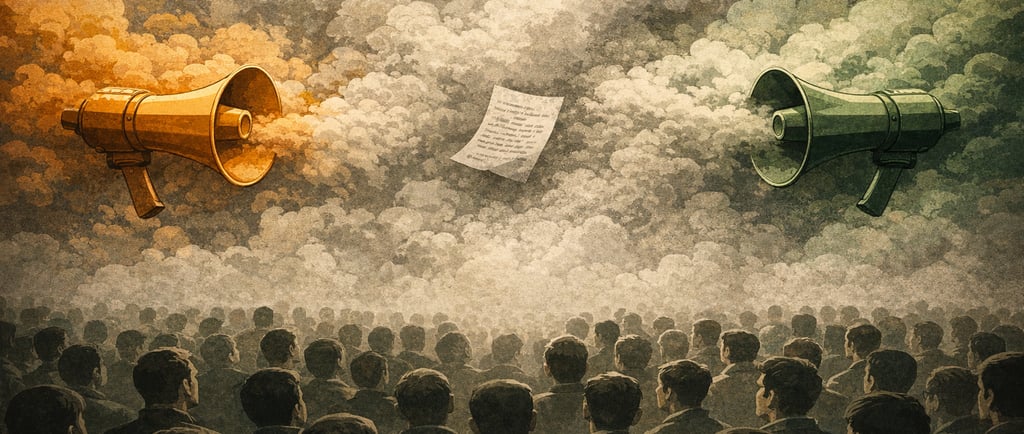

The India-US trade framework is neither a triumph nor a surrender. Both sides know this. Both sides are pretending otherwise.
On February 2, Donald Trump announced a trade deal with India. Prime Minister Modi responded the same day: “Big thanks to President Trump on behalf of the 1.4 billion people of India for this wonderful announcement.”
On February 11, Rahul Gandhi stood up in Parliament and called the same deal a “wholesale surrender.” He said the Prime Minister had “sold Bharat Mata.”
On February 12, farmers from Punjab to Tamil Nadu burned effigies of both Trump and Modi, calling the deal a death sentence for Indian agriculture.
Here is what nobody in this conversation is telling you: there is no deal.
There is a framework for an interim agreement. The interim agreement itself has not been signed. The formal trade deal, a Bilateral Trade Agreement, is weeks or possibly months away. What exists today is a joint statement, a White House fact sheet that has already been revised once, and a set of promises from both governments that contradict each other.
And both sides of Indian politics are lying to you about what it means.
The Triumph That Wasn’t
The government’s narrative is straightforward: this is a triumph of Modi’s personal diplomacy. Tariffs on Indian goods have come down from 50 per cent to 18 per cent. “Made in India” products now have better access to the world’s largest market. Agriculture and dairy are fully protected. Piyush Goyal called it “a historic turning point that will reshape India-US relations and accelerate our journey towards Viksit Bharat 2047.”
This narrative is not entirely false. It is, however, carefully constructed to hide what India gave up and what remains uncertain.
Start with the tariff reduction. The 50 per cent tariff was not a normal trade barrier. It was a punitive rate that Trump imposed in two stages: 25 per cent as a “reciprocal tariff” and another 25 per cent as punishment for India buying Russian oil. Reducing it to 18 per cent was not a concession Trump made out of generosity. It is the removal of a penalty, in exchange for India agreeing to stop buying Russian oil. The government is celebrating the end of a punishment as though it were a gift.
Then there is the question of what India promised in return. The joint statement says India will “eliminate or reduce tariffs on all US industrial goods and a wide range of US food and agricultural products.” That is a sweeping commitment. Piyush Goyal says agriculture and dairy are protected. The US Secretary of Agriculture, Brooke Rollins, says the deal will “export more American farm products to India’s massive market, lifting prices, and pumping cash into rural America.”
Both cannot be true. If Indian agriculture is fully protected, American farmers have nothing to celebrate. If American farmers are celebrating, Indian agriculture is not fully protected.
And here is where it gets genuinely alarming. The White House issued a fact sheet on February 9 that included “certain pulses” in the list of products on which India would reduce tariffs. Pulses. The foundation of dal. The primary protein source for hundreds of millions of Indians. India’s Agriculture Minister, Shivraj Singh Chouhan, had declared days earlier that “importing pulses from abroad is not joy, but shame.” At the same event, he defended the trade deal, saying it protects Indian farmers.
By February 11, the White House had quietly revised the fact sheet. “Certain pulses” disappeared. The word “committed” was changed to “intends.” The reference to India scrapping digital services taxes was removed. The Indian government called this a “diplomatic win.”
It is not a diplomatic win. It is evidence that the two governments do not agree on what they agreed to. The joint statement says one thing. The White House fact sheet said another. The revised fact sheet says a third. And Commerce Minister Goyal has clarified that the $500 billion purchasing figure is “not a binding purchase obligation” but “a projection based on commercial demand.”
This is not a historic deal. It is a press release with contradictions.
The Surrender That Isn’t
The opposition’s narrative is equally straightforward: this is a complete surrender. India has been bullied into submission. Farmers will be destroyed. Data sovereignty is gone. Energy independence is finished. Rahul Gandhi said the Prime Minister had been “choked” into selling the country.
This narrative is also not entirely false. And it is also carefully constructed to maximise outrage while obscuring inconvenient details.
Start with Rahul’s tariff claim. He told Parliament that India’s average tariff went “from 3 per cent to 18 per cent.” This is misleading. India’s tariffs on American goods were not 3 per cent before the deal. India has historically maintained some of the highest tariff barriers among major economies, with rates on agricultural goods reaching as high as 37 per cent, according to the White House. What has changed is America’s tariff on Indian goods, which was punitive at 50 per cent and has since come down to 18 per cent. The 18 per cent rate puts India broadly in line with other major Asian exporters. It is not ideal, but calling it a surrender misrepresents where India stood before Trump’s tariff war began.
Then there is the agriculture panic. Farmers are protesting a deal that has not been signed. The Samyukt Kisan Morcha called it a “total surrender of Indian agriculture to American multinational corporations.” But the interim agreement framework does not contain a comprehensive agricultural Free Trade Agreement. It covers specific products: dried distillers’ grains, red sorghum for animal feed, tree nuts, fruit, soybean oil, wine and spirits. These are significant concessions, but they are not the wholesale opening of Indian agriculture that the opposition is describing. Sensitive products like wheat, rice, maise, ethanol, tobacco and dairy have been explicitly excluded, according to the Indian government.
The opposition is also protesting the oil commitment. India’s agreement to stop buying Russian oil is a serious geopolitical concession, and the opposition is right to question it. But the framing, that the US will now “decide who we buy oil from,” overstates what the agreement says. What Trump extracted is a commitment to shift purchases away from Russia, not operational control over India’s energy procurement.
And here is the opposition’s biggest blind spot. They are protesting this deal as though the alternative was no deal at all. The alternative was 50 per cent tariffs. Indian textiles, leather, gems, pharmaceuticals, and engineering goods were being priced out of the American market. The status quo was not sustainability; it was slow strangulation. A responsible opposition would acknowledge this while demanding better terms. Instead, Congress is calling it a “Trap Deal” and demanding it be scrapped entirely, without explaining what India should do about the 50 per cent tariff wall it was facing.
The Mess Neither Side Will Admit
What is actually happening is something neither side wants to admit, because neither narrative survives contact with it.
India was caught in a vice. Trump imposed punitive tariffs. India needed them reduced. The price was high: concessions on industrial tariffs, agricultural market access, a commitment to buy $500 billion in American goods, and a politically humiliating agreement to stop buying Russian oil. In exchange, India had its tariff rates brought roughly in line with those of competitors like Vietnam and Bangladesh.
This is not a triumph. It is damage control. The government does not want to say this because “we limited the damage” is not a slogan that wins elections. So it says “historic turning point.”
This is also not a surrender. It is the least bad option available under extreme external pressure. The opposition does not want to say this because “they could have done slightly better” does not make for a good speech in Parliament. So it says “sold Bharat Mata.”
The reality is messy and unsatisfying and does not fit on a placard. India gave up more than the government admits. India got more than the opposition acknowledges. The terms are incomplete, contradictory between the two governments, and are still being negotiated. The final deal may look very different from what exists on paper today.
But messy and unsatisfying does not trend on social media. It does not fill a news cycle. It does not mobilise farmers or win applause in Parliament.
The Real Failure
I study political communication for a living. And what strikes me about the trade deal debate is not that politicians are spinning. Politicians always spin. What strikes me is that both sides have independently decided that the Indian public cannot handle complexity.
The government has decided that Indians cannot process “we were in a bad position and we negotiated the best outcome available.” So it presents a framework as a finished deal, a tariff reduction as a gift rather than the removal of a punishment, and a set of contradictory statements as a “diplomatic win.”
The opposition has decided that Indians cannot process “this deal has real problems but it also has some logic given the circumstances.” So it presents every concession as a catastrophe, every compromise as a betrayal, and a framework that excludes most sensitive agricultural products as the death of Indian farming.
Both sides are treating voters as consumers of emotion rather than citizens capable of evaluation. The government sells hope. The opposition sells fear. Neither sells information.
And the people caught in the middle, the actual farmers, the actual textile workers, the actual software engineers whose futures depend on these terms, are left choosing between two fictions. They can believe the government and trust that everything is fine. Or they can believe the opposition and conclude that everything is lost. Neither version equips them to understand what is actually happening to their lives.
What I Would Tell Both Sides
If I were advising the government, I would say this: tell the country you were facing 50 per cent tariffs and that you brought them down to 18 per cent. Tell them the price was real and the concessions were painful but necessary. Tell them agriculture has guardrails, but that the final terms are still being negotiated, and you will fight for farmers in the next round. Stop pretending this is a victory parade. It is a negotiation in progress.
If I were advising the opposition, I would say this: acknowledge the tariff problem India was facing. Acknowledge that some deal was necessary. Then hammer the government on the specific terms, the oil commitment, the data provisions, and the contradictions between the Indian and American versions. Stop calling it a surrender and start calling it a bad negotiation. “They could have done better” is a stronger argument than “they sold the country,” because one is credible and the other is theatre.
But neither side will do this. Because honest communication requires trusting your audience, and in Indian politics, both sides have concluded that trust is a luxury they cannot afford.
The farmers burning effigies in Punjab deserve better than two competing fictions. They deserve to know what is actually in this framework, what is still being negotiated, and what their government has committed to and has not. They are getting slogans instead.
Both sides are giving them slogans. Both sides are lying. And the only people paying the price for this mutual dishonesty are the ones whose livelihoods actually depend on what happens next.