
India Today's Impossible Survey: How a Popular Leader Governs a Doubting Nation
While analysing the findings of the recent India Today-CVoter Mood of the Nation Survey 2025, I discovered some anomalies that led me to revisit their MOTN surveys of the past. What I found was a series of issues, which I will write about in my future blogs, but this story deserved to be told now.
ECONOMYLEADERSHIPBJPPOLITICSELECTIONSMOOD OF THE NATIONINDIA
As someone who analyses political data daily, I've just encountered something that should alarm anyone who values democratic measurement: India Today's latest Mood of the Nation survey presents mathematical impossibilities that would make any serious political strategist question whether they're reading polling data or political fiction.
This isn't a partisan disagreement. It's a professional alarm at methodology so flawed it produces results that violate basic political logic whilst simultaneously revealing something profound about the nature of modern Indian democracy.
I've previously praised their methodology for producing coherent and believable results. However, their recent surveys present contradictions so glaring that no serious political strategist could use this data for actual decision-making. More about that in my future writing. Keep watching this space.
The Mathematical Impossibilities
India Today wants us to believe these simultaneous truths exist in the same population:
Nearly half the country, 48 per cent, believes democracy is "in danger", their highest recorded figure. Only 37 per cent trust the judiciary "a great deal." The government's economic performance has collapsed so dramatically that Modi's advantage over Manmohan Singh shrank from 22 percentage points to just 2 points in six months. Almost half rate anti-corruption efforts as poor.
Yet somehow, in this same electorate allegedly experiencing a democratic crisis and economic catastrophe, Modi maintains 58 per cent approval ratings whilst the NDA projects to 324 Lok Sabha seats. Modi leads Rahul Gandhi by 27 percentage points as the preferred Prime Minister.
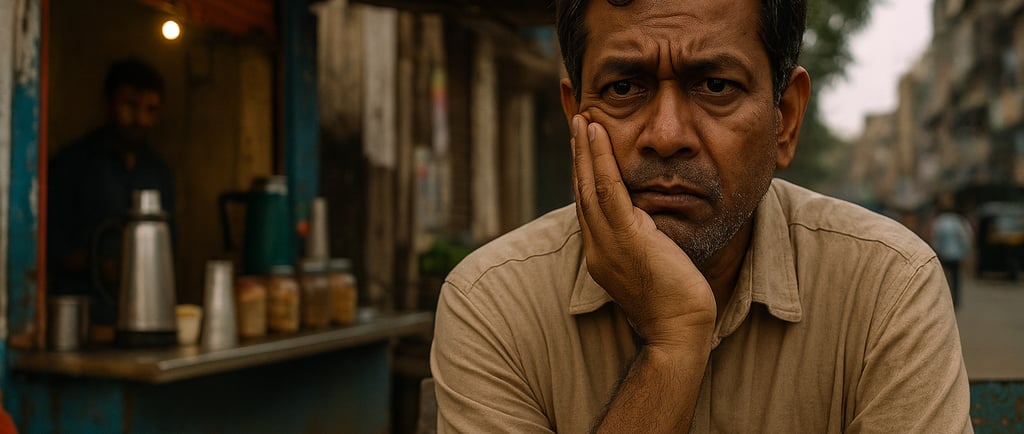
This describes two different countries: one experiencing institutional collapse and economic crisis, and another expressing strong political confidence. Both cannot exist simultaneously in the same electorate.
The Systematic Methodological Failure
These August impossibilities represent the culmination of a methodological breakdown that's been building throughout 2024. In August 2024, India Today claimed Modi's preferred PM ratings had dropped to 49 per cent. During the exact same period, Ipsos measured his approval at 70 per cent. Professional polling organisations don't show 21-point differences on the same leader unless one has serious methodological problems.
The alleged economic performance collapse is equally suspect. Modi's advantage over Manmohan Singh on economic management allegedly fell from 22 points to 2 points in six months. This represents a catastrophic perception shift that typically accompanies hyperinflation or a collapse in financial systems. Yet no such economic catastrophe has been reported. India's GDP growth remained stable, inflation stayed reasonable, and equity markets hit record highs.
Such dramatic perception shifts without corresponding reality changes indicate measurement failure, not political dynamics. Professional pollsters investigate anomalies. India Today simply publishes contradictions. Or is this India Today’s way of showing that all the data our government is throwing at us is flawed, and reality is far away and very grim from what our government is leading us to believe in?
The Real Story Behind the Impossible Numbers
Yet here's where the flawed methodology accidentally reveals something fascinating about contemporary Indian politics. Strip away the mathematical impossibilities, and what emerges is the most intriguing puzzle in modern democratic governance: how does a leader maintain electoral dominance whilst presiding over a populace increasingly anxious about jobs, inequality, and institutional erosion?
The answer lies in understanding that dissatisfaction need not translate into electoral rejection, particularly when alternatives lack credibility. Even respondents expressing serious concerns about unemployment, corruption, or democratic norms may view these as systemic problems requiring strong leadership rather than leadership change. Modi has successfully positioned himself as the solution to India's challenges rather than their author.
This phenomenon, well-documented in political science literature, helps explain why institutional anxiety can coexist with leadership support. When democratic foundations appear shaky, voters often default to familiar authority figures rather than untested alternatives. The psychology of political choice under uncertainty favours incumbents who project decisiveness, even when their actual performance disappoints.
The Opposition's Credibility Vacuum
The most politically significant finding isn't Modi's resilience but the opposition's persistent weakness. Despite steady improvements in Rahul Gandhi's perception and Congress's parliamentary performance, the INDIA bloc cannot project governmental credibility. Regional leaders like Mamata Banerjee command respect in their states but fail to inspire national confidence.
This represents a fundamental failure of political imagination. In mature democracies, sustained economic anxiety and institutional concerns typically generate electoral volatility. That they don't in contemporary India reflects the opposition's inability to construct compelling alternative narratives, not public satisfaction with the status quo.
The survey reveals this starkly in chief ministerial performance rankings. Six of the top ten performers helm BJP-governed states, while not a single Congress chief minister features in the top bracket. This damning evidence of the principal opposition party's sub-national crisis explains why institutional anxiety doesn't translate into electoral opportunity.
The Narrative Control Problem
Operation Sindoor provides a perfect illustration of how even successful governments can lose narrative control. Despite conducting what military analysts consider more comprehensive strikes on Pakistan than Balakot, the government failed to generate comparable political dividends. When only 31 per cent credit Modi with ending the conflict compared to 29 per cent attributing it to American pressure, the government has effectively ceded its most potent political asset.
This narrative failure matters because it suggests the Modi administration's once-masterful communication machinery is losing effectiveness. The gap between military success and political dividends reveals vulnerability that competent opposition could exploit.
The Economic Disconnect That Matters
The most politically dangerous trend lies in economic perception. When Modi's advantage over Manmohan Singh on economic management shrinks to virtual parity within a year despite India maintaining the fastest-growing major economy status, it signals a fundamental shift in public sentiment that macroeconomic success no longer automatically translates into political capital.
The survey captures profound economic alienation. When 56 per cent believe big business benefits most from government policies compared to just 10 per cent citing farmers and 8 per cent small enterprises, it reveals crony capitalism perceptions that undermine pro-development messaging. This economic disconnect creates genuine political vulnerability that extends beyond methodological problems.
The Deeper Democratic Challenge
The flawed polling accidentally illuminates a troubling democratic reality. Citizens can simultaneously express anxiety about institutional erosion whilst supporting those running the institutions they claim are failing. This suggests either profound civic confusion or sophisticated tactical thinking about lesser evils.
The truth probably combines both. Many Indians may recognise governance deficits whilst viewing alternatives as worse. This creates democratic stagnation where dissatisfaction doesn't generate accountability because competitive alternatives lack credibility.
What This Means for Political Strategy
For political professionals, the lesson transcends polling methodology. In hyper-presidentialised systems, issue-based dissatisfaction rarely translates directly into electoral change. Successful challenger strategies require credible alternative leadership, compelling governance models, and superior organisational capacity.
The Modi phenomenon persists precisely because opponents have mastered none of these prerequisites. The Prime Minister may govern a nation harbouring deep doubts about its direction, but faces no rival capable of channelling those doubts into transformative political change.
The Stakes for Democratic Data Measurement
This matters beyond one polling organisation because democratic governance depends on accurate information. When prestigious publications produce mathematically impossible results, they damage more than their reputation. They create cynicism about data-driven analysis and undermine public trust in political measurement entirely.
Citizens deserve polling that illuminates rather than obscures public opinion. Political professionals require reliable data for strategic planning. Democratic discourse depends on accurate sentiment measurement. None of these functions operates effectively with methodologically chaotic polling that produces contradictory results.
The Tough Choice
India Today faces a stark choice: acknowledge the methodological crisis and return to professional standards, or accept irrelevance to serious political analysis. The solution requires temporal controls to avoid contamination from breaking news, question neutrality that prevents priming effects, and cross-tabulation transparency that reveals rather than conceals contradictions.
Most critically, it means investigating impossible results rather than publishing them. When surveys show institutional confidence collapsing whilst political support strengthens, professional pollsters examine their methodology rather than accepting mathematical impossibilities.
The broader lesson extends beyond methodology to democratic health. When dissatisfaction cannot find effective political expression through competitive alternatives, it creates dangerous stagnation. The Modi paradox may persist because his opponents remain incapable of channelling genuine public concerns into credible governance alternatives.
Democracy thrives on both accurate measurement and effective competition. India Today's polling crisis reflects deeper problems with both. Until these fundamental issues receive attention, we'll continue witnessing the curious spectacle of a popular leader presiding over an increasingly doubtful nation, with neither polling nor politics providing satisfactory explanations for this enduring contradiction.
The evidence of methodological failure is overwhelming. The political implications are profound. The choice for democratic institutions is clear: prioritise accuracy and accountability, or accept the slow erosion of public trust that makes both measurement and governance increasingly meaningless exercises.