
She Waits. He Pays. The State Calls It Welfare
Sumitra waits at a counter for the money the state already owes her. Six hundred kilometres away, Anand watches the same state take its share of his before he ever sees it. One has been made a permanent recipient, the other a permanent donor. Neither is the other's enemy.
ECONOMYPOLITICSDEMOCRACYSOCIO-ECONOMICSINDIAWELFARE POLITICSGOVERNANCEPOLITICAL ECONOMYLABHARTHIINCOME TAXMIDDLE CLASSDBT SCHEMES
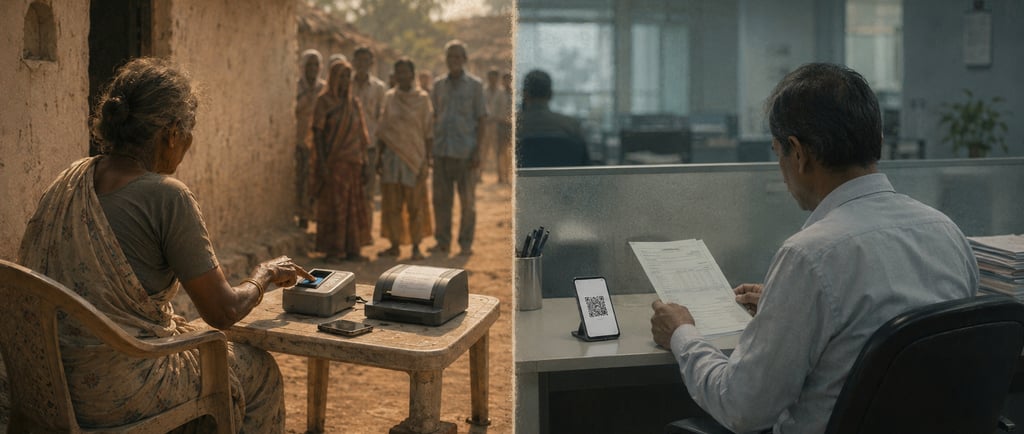
The counter is just an old plastic table set up outside a neighbour’s house, with one leg propped up on a brick. There’s a small grey scanner, a phone, and a printer that prints slowly but heats up quickly. Sumitra arrives early, before the sun gets too high, since the network works better in the morning and the man running the counter closes whenever he wants.
She is around sixty-two, but she looks much older. She has worked with her bare hands since she was a girl, and that has taken its toll.
She gives her number. The man looks up her bank account details on his phone. She presses her thumb on the scanner’s glass. The screen waits, blinks, and then says no.
She tries her first finger, then the next, then the side of her thumb, pressing harder each time, as if more effort might help. At first, the man is patient, but soon he isn’t. People are waiting behind her. She wipes her thumb on her sari and tries again. The scanner still says no.
She knows the money is there. It is her work that has gone missing. Years of cutting, lifting, washing, and harvesting have worn away the ridges on her fingers, so the scanner that should return her money can’t find the woman who earned it. The body that did the work is now the body the state doesn’t recognise.
So she will return tomorrow to try her luck again with a prayer on her lips. If that doesn’t work, then she has to take the bus to the block office, which will cost her more than the wage she’s trying to collect. She has calculated this many times.
Sumitra is just one woman, but there are tens of millions like her.
What she is given
Let’s start with what is good, because it truly is, and Sumitra herself would be the first to say so.
Now, the money is hers in a way it never was before. In the past, her wages went through many hands, and each person took a cut, so what she finally got was less than she was owed and often arrived late, sometimes by months, sometimes not at all. Someone in her place once waited three years for money the state had already promised. That world was harsh. The middlemen were never on her side.
Now, the money goes straight into an account in her name. When the scanner works, it reads her fingerprint clearly, and no one stands between her and her money. She has a bank account, something she never had before. She has her own number and a claim the state records. For someone who started with none of this, it means a lot. Anyone who says the old way was better has never stood at the counter or waited three years for their pay.
Once a month, she also gets a sum she didn’t work for at all, fifteen hundred rupees, in her name, because a few months before an election, the government decided women like her should have it. It isn’t only her state. Across the country, whatever party is in power, a sum like it shows up in the same season, the months before a vote. The first time, she didn’t know it had arrived. The message was in letters she couldn’t read and a code that meant nothing to her, so she thought, like many women, that the money hadn’t come. But it had. She learnt to recognise it by its shape on the page, the way you might know a face from far away by its outline, not its name.
There’s something else on that page she now recognises, a face. The slip shows a leader’s face and the word ‘mine,’ as if the money were a personal gift from him. But a gift is given from what is the giver’s, and this is given from what is everyone’s, her own work and her neighbours’ and the tax of people she’ll never meet, with a single name signed across it. She has learnt the face, understood the word, and learnt to feel grateful for it. That gratitude is part of what the money pays for.
What is taken
The same hand that gives also takes, just on another day.
She worked on the day she wasn’t paid for. The work is counted now by a photograph, taken twice, once before noon and once after, of the group at the site. That day, she arrived late, so the picture was taken without her, and the record says she wasn’t there. There’s no one to tell. The man with the phone just takes the picture; he doesn’t decide what it means. The office is a bus ride away. The day is lost.
Even the wages she earns don’t always reach her. The money goes to whatever account her number is linked to that day, and once, when the link was wrong, it went to someone else’s account. There was no theft, no one to blame, and nothing she could do. The money was sent, the record says so, but it never reached her.
And then there’s the quietest thing of all. Once a year, she has to prove she is still herself, still alive, and still entitled. If she misses the date, her name is removed from the list. There’s no refusal, no letter, no one who looks at her and says no. The date just passes, and her name disappears. Earlier this year, in one state, nearly seventy lakh names were removed from such a list because a date was missed. Most of those women are real and entitled, but they simply weren’t reached in time. Nobody turned them away. There was no one to do it.
This is Sumitra’s life with the state. The money they call a gift is real. The face on the slip is real. Her worn thumb is real. The day that wasn’t counted is real. The name that vanished without anyone saying so is real. These aren’t separate stories; they’re all part of the same arrangement, just seen on different days.
The man who pays
Six hundred kilometres away, Anand sits at his desk, held by the same arrangement, but from the other side.
He is forty-two. He earns a salary, which already makes him different, and from that salary, he pays income tax, which sets him apart even more. Fewer than one in fifty Indians pays income tax. Of those who file a return, only about a third actually owe anything. Anand is one of them. Simply put, he is the man who pays.
He gets paid once a month by his employer, along with a pay slip. He stopped reading most of it long ago. He only looks at one line near the top, the amount he never actually holds, counted and taken out before the rest reaches him. While Sumitra’s money sometimes goes missing on its way to her, Anand’s is taken openly, with his name right next to the figure. He can’t delay, arrange, or hide it. Someone paid in cash for unrecorded work has choices Anand doesn’t. His income is as clear as Sumitra’s thumb is worn. The state sees every rupee he earns, and takes its share before he sees it himself.
Anand is just one man, and there aren’t many like him. That’s the point.
What his taxes build
Let’s start with the good, because it’s true, and because it’s easy to see the man who pays as someone who’s only being robbed.
He does get something in return. The roads he drives on are real, and they’re better than before. The country has built them faster than ever. The trains run; there are new, shinier, air-conditioned trains, and now almost all the lines are electrified, which wasn’t the case when he was a boy. The QR code he scans and uses every day on his mobile, to pay the vegetable seller, the chemist, or the pump attendant who fills petrol in his scooter, works every time for everyone, rich or poor. Nearly half the world’s instant payments go through it. It cost him almost nothing, and it works better than anything built in richer countries. He uses it without thinking, and his taxes helped make it possible. It’s a real, everyday benefit. The man who pays does get something, and if he’s fair, he admits it.
What he does not get back
His child doesn’t go to the school his taxes helped build. He visited the government school at the end of the lane next to his house once, stood in the corridor, and did the maths that millions of families do quietly, one at a time. Then he took his daughter to a different school, paid a fee that took a month to save up, and signed the receipt without a word. For every rupee a family spends on a government school, they spend eight or nine times as much on a private one, or more. Anand pays that extra money on top of the tax he already paid for the school he would never use. He doesn’t protest or write to anyone. He silently pays twice, once in taxes for the school that never works for him, and once in fees for the one that works.
Then, when his mother falls ill, Anand finds himself at a counter too, this time at the private hospital’s billing window. Unlike Sumitra’s, this counter has never failed him. It always recognises him. The bill prints out quickly and clearly, and when he reads the number, he has to read it again. It’s several years of savings gone in one afternoon. He earns too much for the government medical scheme meant for the poor, as it says plainly, and he earns too little for the insurance the rich can easily buy. He sits in the middle, along with hundreds of millions of others, where the poor man’s scheme won’t help, and the rich man’s policy is out of reach. Every year, the cost of illness pushes tens of millions of Indians below the poverty line. Anand spends his life just above it, paying out of pocket for care his taxes were supposed to cover, and praying the worst year never comes.
Then, he has to plan for his own old age. No one is saving a pension for him. The government clerk will retire with a steady income from the state, but Anand will retire with only what he’s managed to save. Some nights, after everyone is asleep, he sits with the numbers: the EMIs, the rent, the school fees, the hospital bills, and the taxes already taken out, and counts what’s left for the years when he won’t have a salary. The number scares him, and the fear is real, because there’s no safety net except the one he can build for himself.
When Anand feels angry, it’s not at Sumitra, whom he has never met, and he would not grudge her the fifteen hundred rupees even if he had. His anger has nowhere to go, and that’s its own problem. He looks for someone to blame for his struggles, but finds no one. There’s no name of a leader on his tax, no scheme in his name, no word that says ‘mine’ on his payment, and no slip that thanks him. He pays the most and gets the least thanks, because what he wants in return is a functioning school, a reliable hospital, and a safe old age, and none of those is a thing a leader can hand a man on a stage before an election. His grievance is real, but he stays silent.
What it does to each of them
I’ve spent thirty years close to this, in the rooms where these schemes are created and branded, and near the desks where these taxes are paid. Keep both of them in mind, because each story only makes sense next to the other.
Look at what life on the receiving end has done to Sumitra. She watches for a slip she can’t read, but she has learnt to recognise the face on it and learnt to thank it. Something about her relationship with the state has quietly changed. Years ago, under the old laws and campaigns, she was someone with a claim; she could walk into an office, demand what was hers by right, and complain if she didn’t get it. Now, she’s become someone who waits for a ‘gift’ from the leader, feels grateful when it comes, and has no one to complain to when it doesn’t, because no one actually refused her. A claimant has someone to hold accountable. A recipient only has someone to thank. The shift from one to the other is everything that’s happened to her, and it happened so gently she can’t say when.
Now look at what life on the paying end has done to Anand. It’s the opposite situation, but the same helplessness. He isn’t grateful, and he isn’t waiting. He pays on time every month, more than almost anyone around him, but he also has nowhere to turn. The state doesn’t offer him a better deal, just more explanations. He can’t walk away from the tax the way he walked away from the school. He stays, keeps paying, and the resentment just builds up inside him with nowhere to go.
This is what I’ve seen from the inside, and it’s easier to feel than to explain. A state that depends on the gratitude of recipients has no reason to reduce their numbers. A state funded by a small group of payers has no reason to expand that group. If a woman like Sumitra moved out of need, she’d stop being grateful. If a man like Anand felt well served, he’d stop resenting and start expecting more. Either one, set right, would loosen the hold. So the distance between Sumitra and Anand is not a fault someone forgot to mend. It is the thing working as it was built to work. No one set out to be cruel. The arrangement only answers, year on year, to what keeps it standing, and what keeps it standing is the two of them held where they are.
The state has a scheme for every stage of Sumitra’s life and a claim on every rupee Anand earns, but it gives her no way to move up and him no way to get out. It calls all of this welfare. For her, it’s a gift she must be grateful for. For him, it’s a bill he has to keep paying. The real cost of keeping the whole thing alive is that both of them are kept in their places.
Where it leaves them
Sumitra will remain a recipient for the rest of her life. Her thumb won’t heal, and the deadlines will keep coming. The face on the slip might change with each season and election, and she’ll learn to recognise the new one and thank it.
Anand will continue to be a donor for the rest of his life. The tax will be taken first every month, before he even sees his pay. School fees will rise faster than his salary. The hospital bill will come in a year he can’t predict. He’ll have to fund his old age on his own.
They will never meet. Even if they did, they’d have little to say and nothing to argue about, because neither has done anything to the other. She isn’t the reason he pays, and he isn’t the reason she waits. They stand at opposite ends of a long arrangement that depends on keeping them both where they are.
One pays with gratitude. The other pays with money. Both are keeping alive something called care, but it doesn’t help either of them stand on their own.