
The Name Comes First
Two weeks before a women's scheme launches, a young man in a state communications cell sends the design back. The face is too small. He does not yet know what the scheme will do. He knows its name. A piece about how the credit gets built first, and the welfare gets built to fit it.
POLITICAL COMMUNICATIONPOLITICSLABHARTHIPROPAGANDABRANDINGCAMPAIGN STRATEGYDEMOCRACYPOLITICAL STRATEGYDBT SCHEMESCOMMUNICATIONINDIAWELFARE POLITICSMONEY IN POLITICSGOVERNANCE
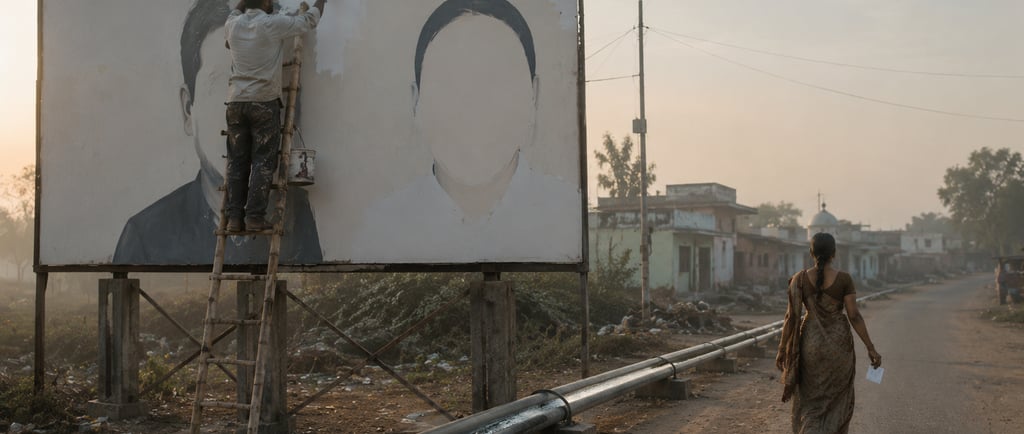
Rohit is twenty-eight. The scheme launches in two weeks, and what catches his eye on his computer screen in a brightly lit desk in the Jansampark office is the face. It looks wrong.
The face is too small. The Chief Minister's photo sits in the corner of the design the agency sent back. It looks tasteful and balanced, just as a designer would want. But Rohit doesn't care about balance. He sends it back with a short note: make the face bigger by half. The blue is also wrong. It's the standard government blue, the same as a tax notice. It's not the shade everyone in the state instantly connects to one person.
He still doesn't know what the scheme will actually do. The amount is being decided by people above him. The eligibility rules keep changing. What he does know, because it reached him first and fully formed, is the name. The name arrived a week ago from an office he's never been in. Everything else is being shaped to fit that name.
Some time ago, I wrote about a woman at a counter who learnt to recognise a face on a slip she couldn't read, and learnt to thank it. This is the desk where that face was picked, photoshopped, and coloured. I've spent thirty years near desks like Rohit's. The important thing isn't that the state advertises; every state does. What's new is that advertising now comes first, and the scheme is built to fit the ad, not the other way around.
A regular company makes a product first, then wraps it. It builds a car that works, then films it on a mountain road. Even without the film, the car still runs. But the state-funded machine has learnt to do things the other way. The wrapping, like the name, the face, and the launch date, comes first, and the actual scheme is built to fit that. The money is real, and I want to make that clear from the start. This is the largest cash transfer to poor women the country has ever seen. But the shape, name, size, timing, and the face on it are all decided by who gets the credit. The credit isn't just an extra layer. The credit is the plan.
What the rules allow
There are rules about this. A court laid them down about a decade ago, tired of governments spending public money to photograph their own leaders. Government advertising, it said, must be politically neutral. No party name. No party symbol. No flag. The faces permitted were three, and only three: the President, the Prime Minister, the Chief Justice. For about a year, that held.
Then the very governments the rule was written to restrain asked for it to be relaxed, and it was. The list of permitted faces was widened to include Chief Ministers and the ministers of the concerned department. A committee was supposed to be set up to monitor the content and to recommend to the ministry, and do no more, leaving the ministry as the judge of its own advertising. Most states never troubled to set up a committee at all.
But the real story isn't that the rule got weaker. The real story is that the rule was never as strict as it seemed. Look at it again. It bars the party. It says nothing about the office, nothing about the dead, nothing about the gods. And of course, nobody was ever going to put the Chief Justice on a hoarding.
So the scheme is named for the office. Not the party, the office. The Chief Minister's scheme, the Prime Minister's scheme. The office is held by the party leader, but an office is not a party, and the rule is satisfied. Or it is named for the party's own founder, years dead, whose name is not the party's name and breaks nothing, and whose memory the party owns outright. Or, sometimes, it is named for a goddess. Lakshmi. Gruha Lakshmi. Subhadra. Annapurna. A goddess is neither a living politician nor a party symbol, so the rule has nothing to say. Something is gained that no rule could ever have granted: the transfer is now holy. To question a scheme named for the goddess of the household is no longer to question a budget line. It is to set yourself against the goddess, and the household, and the woman in it.
Now add the face, which is allowed, and the familiar colour, which was never banned, and you get a hoarding that names no party, shows no symbol, breaks no rule. Every voter who passes by understands it. The prefix is not just a loophole in the advertising rules. It is a carefully structured design intended to follow them. The people who create it do not see it as breaking rules. They see it as doing their job well.
None of this is new
You might think all of this is new, but it's actually old and shared by everyone.
The clearest ancestor is more than fifty years back, a single slogan that promised to remove poverty and tied the promise to one leader's name. It answered an opposition cry to remove her with a cry to remove poverty instead, and it worked, and it returned a landslide. What it delivered on the ground was slow and mixed. What it delivered as a technique was permanent: the idea that the state's care for the poor could be routed through one person's name, that the leader could stand between the citizen and the relief and be thanked for it. Every scheme since has borrowed from that.
The party that ran it went on to write its own family's names across the face of the state for decades. A housing scheme, an electrification scheme, an employment scheme, each carrying a first name from the same household, so that a poor family's dealings with the government, the roof, the light, the wage, all came stamped with one family's memory.
And older still, in the south, a tradition deeper than any of it. A matinee idol turned Chief Minister took a school lunch scheme a predecessor had cooked and relaunched it under his own name, and the women who ladled the food were understood to remind the children whose gift they were eating. That was more than forty years ago. In that state, the leader-as-provider is not a tactic. It is the grammar of politics, and it has run through every party that has held power there.
So when I say the credit comes first, I am not pointing out a new problem or blaming one party. This is the basic incentive for anyone in power in a poor country with elections: attach your name to the relief, because relief brings loyalty and the name collects it. The impulse is not new. What is new is the machinery. Now, the name is always a prefix, the face is everywhere, and the money goes straight to bank accounts, so gratitude is direct. Everything, name, face, timing, and transfer, has become one product that any party can use. The tools have improved, but the motive is as old as voting itself.
Where the face went
The face was removed from the hoarding, and that's the clever part.
A hoarding is an advertisement, and advertisements are what the rules watch. So the face left the hoarding and went where the rules do not look: onto the thing the woman carries home. It is on her scheme card, in her purse, beside her money. It is on the sack of grain. It is on the letter that says her payment is approved, and on the certificate that says she is a beneficiary. None of these is an advertisement. Each is a product or a document, and the rules governing hoarding say nothing about a card in a purse.
And the card in the purse is seen far more often than any board on any road. She takes it out at the shop, at the bank, at the camp. Her neighbour sees it. Her daughter sees it. The face is there each time, small and close and permanent, in a way no roadside hoarding could manage. The woman I wrote about earlier learnt to recognise a face on her slip and learnt to thank it. That was not an accident of design. That was the design. The face was put where she would have to hold it.
The photograph you take for them
There's a new tactic now, and it's worth looking at because it does something different from the others.
The others put the leader's face in front of the citizen. This one turns the citizen into the person who spreads it. The governing party's app runs campaigns in which you perform some small act of service, sweep a lane, plant a sapling, help at a camp, and photograph yourself doing it, and upload the photograph. For this, you earn points. The points place you on a leaderboard. The leaderboard returns a certificate carrying your name beside the leader's. And your uploaded face, with thousands of others, is stitched into a single portrait of the leader, so that the picture of him is made, literally, out of the faces of the people who admire him. The campaign tends to run around his birthday.
At the enrolment camps, the same logic runs in the flesh. The woman is photographed holding her acknowledgement in front of a backdrop displaying the scheme name and the leader's face, and the photograph is tagged with the place and sent up the line to where someone like Rohit watches the count climb on a dashboard through the evening.
This deserves its own paragraph. In this country, there is a kind of political machine that runs on unpaid devotion. People give their time and energy just because they believe in something. You cannot buy that kind of loyalty; if you pay for it, it stops being real. The state-funded machine knows it cannot buy this fuel. What the app does is borrow it. For a few hours, usually around a birthday, it gets regular people to boost the leader's visibility for free, makes them feel good about it, and even gets them to compete. It is the only thing the machine cannot buy, so it borrows it for a short time and gives it back by the end of the day.
Four points on one line
If you pay attention to when these schemes are launched, you stop seeing just welfare and start seeing a calendar at work.
The launch is set for a date that carries weight. A leader's birthday. A festival. A founder's anniversary. The first instalment is timed so that the money lands just before a festival and is described warmly as the festival gift arriving early. In one state, ahead of a local poll, the government pushed two months of payments out in advance, before the date when the election rules would freeze fresh announcements, and said so openly that the festival money was coming early this year. The rules stop a party from campaigning. They do not stop a government from advertising its own schemes, and the schemes are the campaign.
Then there is the shape of the roll, which swells before a vote and shrinks after it. In one large state, a women's scheme grew, in the months before an election, to nearly two and a half crore names, the eligibility loose and the checking light. The party won. Then, once the votes were counted, verification began: identity checks, income checks, cross-matching, and the roll was pared back by the better part of a crore. The next year's budget for it was cut by roughly a quarter.
There are two honest ways to read that, and I will give you both, because the evidence does not allow me to give you one. The first is that the roll was generous by design before the vote and quietly corrected after it, that the loose checking was the point, that the men and the taxpayers and the plainly ineligible who slipped on and drew the money for months were the price of a bigger number to hold up before polling. The second is that a scheme launched in a hurry, months before an election, could not be checked in time, and that the pruning afterwards was the honest correction of a rushed start, removing people who should never have been on it. Both are true to the facts. What is not in doubt is the sequence: the generosity came before the vote, and the checking came after, and that sequence holds whichever motive you assign to it.
It is not one party. In another large state, under an entirely different party, the same kind of women's scheme was found after the election to have been paying women who had died, and a verification drive struck several lakh names off. The colour was different. The sequence was the same.
The scheme launch, the rise in the amount, the surge of advertising, and the poll are four points on one line. Every government that has faced an election in this country has drawn that line, and I have helped draw it. It is not corruption, and it is not a mistake. It is a calendar, and the calendar is the plan.
The money is real
Now I need to pause and make the strongest case against everything I have just said. If I do not, I would be doing exactly what I criticise: showing you only one side and hiding the rest.
The money is real. This is not a small point, and I will take it seriously. For the first time in the country's history, a poor woman receives a fixed sum every month in an account that is hers, in her own name, with no husband, no broker, and no clerk standing between her and it. The middleman who took his cut at every step for seventy years is gone. The largest direct transfer of resources to poor women this country has ever seen is not a phrase in a manifesto. It is happening in tens of millions of accounts every month. A woman who has never in her life held money that was indisputably her own now holds it. To stand at a distance and call that branding is a comfort available only to people who have never needed the fifteen hundred rupees.
And the numbers refuse the cheap version of my argument. If the credit had truly replaced the scheme, you would expect the advertising to swallow the budget. It does not. Where anyone has managed to measure it, the money spent shouting about these transfers is a tiny fraction of the money transferred, a fraction of a single per cent. There is one prominent case where the advertising did eat most of the money, and it is telling: a campaign to change attitudes about the girl child, a scheme whose whole purpose was the message, with no transfer underneath at all. There, the message was the product, and the spending showed it. That is the exception, and it proves the rule. For the schemes that actually move money, the money dwarfs the noise about it, every time.
So let me be exact about what I am claiming. I am not claiming the advertisement replaced the scheme. It did not. I am claiming something narrower and harder to wave away. The advertising budget is small, but the credit is not limited to it. The credit is in the design. It is in the choice to hand out cash rather than build a hospital, because cash arrives with a name on it and a hospital takes a decade and thanks no one. It is in the choice of women, who are a large, reachable and decisive bloc. It is in the amount, set high enough to be felt and low enough to be borne across a whole state. It is in the name, and the face, and the launch day, and the swell, and the cull. None of that is paid for out of an advertising head. All of it is the credit, shaping the thing from the inside.
Here is something that should trouble both the sceptic and the believer in me. The credit might be what keeps the money coming. A party will fight for a scheme if it can put its name on it. It will protect it in a tight budget, increase it before an election, and defend it from auditors, all because the credit matters. Once the money starts reaching a woman's account every month, no new government can easily stop it, because she will notice, and she votes. So the new government does not end the scheme; it just renames it. In other words, the branding and the vote might be why the poorest woman in the country now has her own income. That is not a comfortable conclusion, but it is true. And a piece that only criticises is not worth your time.
What changes overnight
Which brings me to the thing that gives the whole game away, which is what happens when a government falls.
When a party loses power, almost everything it created stays in place. The scheme keeps going. The money keeps arriving. The rail, the list, the accounts, the monthly transfer, all of it survives the change of government, because taking them away would upset the very women whose votes the new party needs. What changes, overnight, is the paint.
A housing scheme built and named by one party, a first name from the ruling family stamped on every sanctioned house, becomes, after a change in the capital, the scheme of the office of the Prime Minister. Not a brick moves. The houses already approved stay approved. Only the name on them changes. In one state, after one election, the incoming government renamed twenty-one schemes at a stroke, lifting the outgoing founder's name off a whole family of them, and then reached for the network of women's groups the previous party had spent two decades building, the actual living machine out in the villages, and moved to put its own scheme's name on that too. In another state, the moment it won, the new government announced a successor to the old women's transfer, a new name and a new face, the same women carried across intact so that not one of them would feel the change as a loss, only as a fresh coat on a gift she already had.
Here is the one thing I will clearly say is my own view, because I have seen it up close. The new party does not keep the old scheme because it believes in it. It keeps it because ending it would lose votes, and rebranding it costs nothing. It does not fix what works. It just changes the name and takes the credit. That is not cynicism; it is simply the most practical thing a new government can do, and every new government does it.
And the newest winners will do it too. There is a party, just come to power in the south, that has inherited a women's scheme named for the founder of the party it beat. What it does with that name is the thing to watch, and I would not put money on the name surviving.
So this is where things stand. The face on the hoarding is not there to tell you the scheme exists; the scheme would exist without it. The face is there to show you who to thank, and the next government can change it in a day, because it was never the main thing. The pipe beneath it, the money, the rail, the woman's own account, is real and lasting. The name on top was always up for grabs by whoever wins next. Rohit knows this better than anyone. He is twenty-eight, and he will still be at that desk when the government changes, opening a new kit from a new office, adjusting a new face, and picking a new blue. The scheme itself will not change. Only the person to be thanked will.