
The Stadium That Shook: What Nobody Is Saying About India's AI Summit
Every newspaper covered India's AI Impact Summit and the tariff earthquake as separate stories. They ran on the same edit pages, on the same day, completely unconnected. This piece argues that they are one story and that the week at Bharat Mandapam exposed the central, unresolved tension of the AI age: sovereignty on borrowed ground.
ARTIFICIAL INTELLIGENCEDIGITAL INDIAINFRASTRUCTUREINNOVATIONDEMOCRACYINDIAMAKE IN INDIAGOVERNANCEGLOBAL
Nobody is writing this piece, at least not to my knowledge.
Pick up any newspaper from the past week. You will find two stories running in parallel. The first is about India’s triumphant hosting of the AI Impact Summit at Bharat Mandapam, the $250 billion in pledges, the 88-nation New Delhi Declaration, and the diplomatic harvest of a rising power claiming its seat at the table of the fourth industrial revolution. The second is about the tariff earthquake that followed the US Supreme Court’s demolition of President Trump’s trade architecture, the frozen deals, the delegations that never boarded their flights, and the scramble across three continents to make sense of what comes next.
These two stories ran on the same edit pages, in the same newspapers, on the same day. The Economic Times devoted its Tuesday edit page to the blooming of sovereign AI in India and the tariff chaos engulfing the world. Side by side. Unconnected. As though the chips India needs for its sovereign AI ambitions arrive by magic carpet rather than through supply chains governed by the very trade deals that were unravelling in the column next door.
My piece connects them. The AI summit and the tariff earthquake are not two stories. They are one.
India Built the Stadium
India deserves huge credit. India did something at the AI Impact Summit that no previous host managed. It changed the vocabulary.
When Britain hosted at Bletchley Park in 2023, the conversation was about existential risk. Rich countries worrying about whether machines might end civilisation. Seoul in 2024 extended the worry. Paris in 2025 talked about “action” but remained trapped in the same frame. Then India took the baton and, with the confidence of a country with hundreds of millions of people yet to fully enter the digital economy, said: “The word is not ‘safety.‘The word is’ impact.‘”
That reframing was India’s genuine intellectual contribution to the five-summit arc. No European capital could have made it credible. You need a billion-person democracy with both a world-class tech sector and farmers still waiting for reliable broadband to stand up and say: the real AI risk is not that machines become too powerful, but that their power remains locked behind borders most of humanity cannot cross.
India did not just host this summit. It built the stadium, sold the tickets, wrote the programme, and planted the flag. The New Delhi Declaration, for all its voluntary and non-binding nature, carries the weight of a shift in whose questions get asked. From Geneva in 2027, the conversation will have to reckon with what India put on the table: AI governance is meaningless if it does not address who gets the chips, who controls the models, and who decides what “safe” means for people whose most pressing safety concern is a failed monsoon, not a rogue superintelligence.
The ITU’s Fred Werner, speaking to the Economic Times at the summit, put it cleanly. India does not need the world’s largest language models or massive centralised AI factories to be AI-ready, he said. Its strength lies in diffusion and adoption. The Aadhaar-UPI digital public infrastructure model, deployed as a public good rather than a for-profit commercial service, is a replicable playbook for the Global South. That is a genuine insight, and it came out of this summit.
So did $250 billion in investment commitments. Reliance pledged $110 billion over seven years for AI and data infrastructure. Adani committed to investing $100 billion in renewable-powered AI data centres by 2035. OpenAI’s Brad Lightcap called India the company’s second-largest market with 100 million active users and said 2026 would be the year of mass AI adoption. Tata partnered with OpenAI. Infosys partnered with Anthropic. NVIDIA partnered with L&T for India’s largest AI factory. Sarvam AI launched sovereign language models. The voice AI ecosystem began to find its legs.
All of this is real. None of it is the whole story.
Then the Match Started
Here is the chronology that nobody is assembling into a single narrative.
On 16 February, the exhibition opened. Five lakh visitors over the following days. Startups showcased. Investment announcements cascaded. The mood was euphoric.
On 19 February, Prime Minister Modi inaugurated the summit alongside President Macron. The CEO Roundtable convened that evening. The $250 billion headline crystallised.
On 20 February, in the morning, India signed the Pax Silica Declaration, joining a US-led technology and supply chain alliance alongside Australia, Japan, South Korea, Singapore, the UK, and others. The ink was fresh. Ambassador Sergio Gor spoke of limitless potential. Under Secretary Helberg declared that economic security is national security. “We say no to weaponised dependency,” he announced.
Hours later, the US Supreme Court struck down the IEEPA tariffs in a 6-3 ruling. The legal authority under which America had imposed tariffs on every trading partner, under which India’s trade deal had been structured, under which the 18% rate India negotiated was anchored, was demolished. Not by a foreign adversary. By America’s own judiciary.
That same day, at India’s own summit, White House official Michael Kratsios declared: “We totally reject global governance of AI.”
Let that sink in. India spent six days building the case for multilateral AI governance. The United States, sitting in the front row, signed India into its technology alliance in the morning and, by evening, vetoed the foundational premise of India’s summit.
On 21 February, Trump raised the replacement tariff from 10 to 15 per cent. India’s negotiated rate of 18 per cent, the crown jewel of the February trade deal, was now three percentage points worse than the universal rate that applies to countries with no deal at all. The New Delhi Declaration was adopted. Non-binding. Voluntary. 88 nations.
On 22 February, India’s trade delegation to Washington did not board its flight. The three-day meeting to finalise the legal text of the interim trade agreement was postponed indefinitely. “Both sides are of the view that the proposed visit be scheduled after each side has had the time to evaluate the latest developments and their implications,” the Commerce Ministry said.
On 23 February, the EU Parliament froze ratification of its own trade deal with the US. “Pure tariff chaos from the U.S. administration,” said Bernd Lange, chair of the trade committee. “No one can make sense of it anymore.” The UK found itself facing higher duties than it had negotiated. The deal freeze went multilateral.
And today, 24 February, US Customs and Border Protection formally deactivated all IEEPA tariff codes. The legal mechanism that enabled India’s 18 per cent rate to be implemented ceased to exist at midnight Eastern Time this morning.
Sovereignty, Live and in Colour
What happened during summit week was not a coincidence of timing. It was a live demonstration of the paradox India was trying to resolve.
India needs American technology to build sovereign AI. The GPUs that power every data centre announced at the summit, the foundation models that Tata and Infosys will work with, the cloud infrastructure underpinning the billions in investment pledges: all of it flows through American companies, governed by American export controls, enabled by American trade architecture.
India needs an American trade architecture to create the investment environment for that technology. The tariff deal, Pax Silica, the TRUST initiative: these were supposed to be the stable framework within which the AI partnerships would operate.
But the trade architecture proved unstable. Not because India did anything wrong. Not because the summit failed. But because the country whose technology India needs to achieve sovereignty demonstrated, during India’s own showcase, that it can reshape the rules whenever it chooses.
This is the paradox that every optimistic editorial about sovereign AI carefully avoids. Sarvam can build brilliant frugal language models. Voice AI startups can develop speech-to-text for every Indian language. The digital public infrastructure story is genuinely compelling. But the chips those models run on, the GPUs those startups need, the investment capital that makes the data centres possible: all of it depends on a trade and technology relationship with a partner who, in the space of 72 hours, had its tariff regime struck down by its own court, raised the replacement rate from 10% to 15% overnight, explicitly rejected the governance framework India was proposing, and created conditions where India’s negotiated deal is arithmetically worse than having no deal.
The Coercive Twilight
Now, it would be easy to conclude from this that the deals are dead and the architecture has collapsed. That would be wrong, and dangerously simplistic.
What Trump did after the Supreme Court ruling was not retreat. It was recalibration. He escalated. The universal rate went from 10% to 15% within 24 hours. USTR Jamieson Greer went on three Sunday shows and told the world that deals remain in force, that countries like Malaysia and Cambodia would continue paying 19 per cent even though the universal rate is lower, and that the administration would “reconstruct” trade policy using Section 301 and Section 232, both of which have survived legal challenges. New investigations were flagged for “industrial excess capacity” across Asia and subsidised rice. Treasury Secretary Bessent said refunds from the struck-down tariffs would be “dragged out for weeks, months, years.”
The message was unmistakable: pull out of your deal, and what comes next will be worse.
Indonesia confirmed it is honouring its 19 per cent deal, signed on Friday itself, after the ruling. The EU froze ratification but has not walked away. India’s delegation stayed home, but nobody said the deal is off. Everyone is “evaluating.”
This is not a collapsed architecture. It is a coercive one. Countries face a perverse choice: honour agreements negotiated under a legal authority that no longer exists, at rates now worse than the universal floor, because the alternative, antagonising this White House, could produce something uglier. Germany’s Chancellor Merz called it correctly. The “biggest poison for the economies of Europe and the US is this constant uncertainty about tariffs.” The uncertainty is not a bug. It is the instrument.
For India’s AI ambitions, this is the critical point. You cannot build long-term technology infrastructure, data centres with decade-long investment horizons, chip fabrication partnerships, or AI training pipelines on a trade foundation that shifts three times in 72 hours and could shift again tomorrow morning by an individual’s whim. Yet that is precisely what every partnership announced at the AI Impact Summit requires.
The Gap in the Coverage
Here is the coverage gap.
The optimists, and there are many, celebrated the summit’s investment haul, India’s diplomatic positioning, and the sovereign AI pipeline. Business Standard called it “a path to take the world forward.” Foreign Policy framed it as a strategic triumph. The Economic Times ran two pieces on sovereign AI on the same day it published Pranab Dhal Samanta’s sharp analysis of how SCOTUS had raised “a serious credibility question for whatever action the White House takes from now on.” Same edit page. Zero connection between the columns.
The sceptics flagged the chaos: the Galgotias robot-dog fraud, the Day One logistical disaster, the Youth Congress protest, and Bill Gates’s withdrawal after the Epstein files. TechPolicy.Press published important critiques about corporate capture and the absence of civil society. All valid. But all missed the larger story.
The analysts at TIME came closest, catching the “growing awareness by middle powers of the need to build their own AI capability” and the uncomfortable truth that computing power, data, and talent remain highly concentrated in the US and China. But even this frame treats the tariff story as backdrop rather than substance.
The think tanks that were supposed to analyse the summit are now analysing the tariff earthquake instead. Brookings published a pre-summit podcast and went silent. Carnegie India had a single quote in NBC and nothing more. Chatham House has produced no post-summit assessment. ORF had pre-summit framing. The analytical class has been hijacked by the event that overtook the event.
The Financial Times, which covered Paris extensively, did not write a standalone editorial on Delhi. The Economist published a scathing piece about VIP culture at the summit. The WSJ editorial board said nothing. The most influential international voices either passed or treated Delhi as colour rather than substance.
Nobody wrote the piece that connects the AI summit to the tariff earthquake. Nobody interrogated the sovereignty paradox not as an abstract concept but as something that played out, in real time, across a single week, in a single venue, on a single nation’s watch.
Calculated Ambiguity as Doctrine
India’s approach to AI governance, dismissed by some as incoherent and praised by others as masterful, is best understood as calculated ambiguity. Sign with everyone. Commit to no one’s regulatory framework. Build domestic capacity while keeping every door open. Join Pax Silica in the morning and chair a multilateral declaration in the afternoon. Partner with OpenAI and build sovereign models simultaneously.
This is not confusion. It is the most sophisticated available strategy for a middle power that needs American chips, Gulf capital, European markets, and its own domestic digital stack at the same time. For a country navigating between great power blocs while building for 1.4 billion people, ambiguity is not a weakness. It is a strategic doctrine.
But the summit week tested that doctrine’s limits with unusual severity. Calculated ambiguity works when the external environment is predictable enough to hedge against. When your most important technology partner can rewrite the terms of engagement between a Friday morning and a Saturday night, veto your governance framework at your own summit, and render your painstakingly negotiated deal arithmetically disadvantageous overnight, the space for ambiguity narrows sharply.
The question India confronted during summit week, whether it knew it or not, is the question Geneva will inherit in 2027: Can the multilateral architecture for AI governance survive the collapse of the multilateral architecture for everything else?
What Comes Next
India’s sovereign AI pipeline is real, and it matters. The frugal language models, the voice AI startups, the digital public infrastructure, the 20,000 new GPUs under the IndiaAI Mission: these are not theatre. They represent genuine capability being built, often with remarkable ingenuity, by people who understand that India’s AI future cannot depend entirely on the goodwill of any single foreign power.
But capability without a stable architecture is potential without a trajectory. The summit showed India at its best: ambitious, entrepreneurial, and willing to change the conversation. The same week showed the world at its most volatile: legal certainties overturned, deals orphaned, alliances signed and undermined in the same breath.
The editorial pages will move on. The tariff story will consume the next news cycle. The summit will be filed away as a success or a spectacle, depending on who is writing about it.
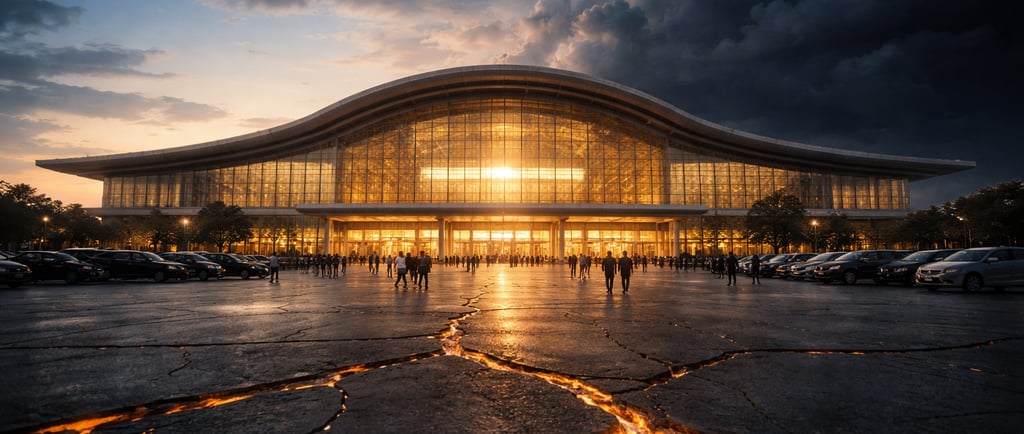
What will remain, though, is the image that captures the week more honestly than any declaration: a country that built the most ambitious AI summit in the series, that packed Bharat Mandapam with the future, that rewrote the vocabulary of global AI governance, and that discovered, while the cameras were still rolling, that the ground beneath the stadium was not its own to steady.
That is not a failure. It is a condition. And until India, or anyone else, figures out how to build sovereign technology on foundations that can be pulled away by a single partner’s court ruling or a single leader’s social media post, it will remain the central unresolved question of the AI age.
Geneva should take note.