
The Untranslatable States
Four states go to the polls. Four Chief Ministers speak political languages that Delhi has never learned. This is not about caste arithmetic or alliance maths. It examines why the most powerful brand in Indian history encounters barriers in Kerala, Tamil Nadu, Bengal, and Assam, and what this means for 2029.
BJPELECTIONSPOLITICSBRANDINGPOLITICAL STRATEGYCONGRESSLEADERSHIPASSAMWEST BENGALTAMIL NADUKERALADEMOCRACYCOMMUNICATION
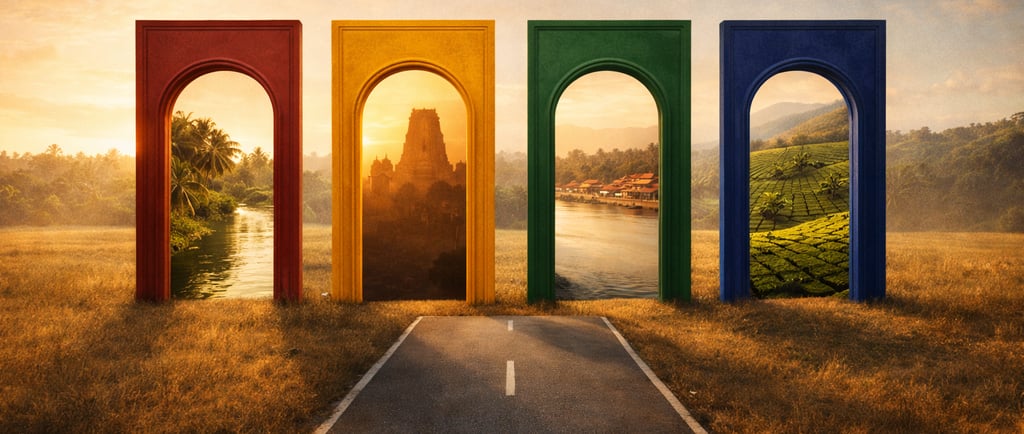
Four elections, four political languages, and a question that no one in Delhi seems to be asking.
I have spent years studying how political brands are built, how they win, and how they fade. In all that time, I have never seen a brand as dominant as the one that has led India since 2014. It wins national elections with ease. It has changed the political vocabulary across the Hindi belt. It has turned opponents into bystanders and bystanders into supporters.
Yet this year, four states are holding elections in which this brand faces a substantial barrier. Not a crack. Not a dent. A wall.
Kerala. Tamil Nadu. West Bengal. Assam.
Every election analyst in the country can explain what is happening in these states: anti-incumbency numbers, caste calculations, alliance deals, and seat counts. It’s the usual horse race.
But no one is asking the more interesting question: Why do these four states, and almost only these four, resist the most powerful political brand in Indian history? What do Mamata Banerjee, M.K. Stalin, Pinarayi Vijayan, and Himanta Biswa Sarma share that makes their states so hard to penetrate?
The answer isn’t ideology, caste, or even incumbency.
It’s language, not the spoken kind, but the political kind.
Each of these four leaders has created what I call a complete political language, an emotional system that works on its own, separate from national politics. It’s a grammar of identity, grievance, pride, and belonging, so deeply rooted that no outside brand, no matter how strong, can fit into it.
India doesn’t have just one political marketplace. It has several. The 2026 elections will show this clearly.
Mamata: The Grammar of Resistance
Mamata Banerjee’s political language is built on one word: asmita. It means Bengali pride, identity, and self-respect.
She is the woman who brought down a 34-year-old communist government by walking, literally, from Kolkata to Singur and back. She didn’t need a war room or a media plan. She just needed a white cotton sari, slippers, and the determination of someone who had been told to wait her turn too many times.
Fifteen years later, the BJP has tried everything against her: the NRC, the CAA, the SIR, Hindu consolidation, and the full strength of Delhi’s campaign machine. Mamata has handled every challenge by doing what she does best: turning each attack into evidence that outsiders are targeting Bengal.
When Bengali-speaking workers were harassed in BJP-ruled states last year, she led a protest march through Kolkata in the rain. When the Special Intensive Revision of voter rolls began, she called it an NRC by another name. When Modi came to campaign, she dared the Centre to put her in a detention camp. “I have decided that I will speak in Bengali more,” she said. “Put me in a detention camp.”
This isn’t a typical strategy. It’s instinct turned into art. Every BJP move is shown as an attack on Bengali identity. Every order from Delhi becomes proof that outsiders don’t understand Bengal. Even the BJP’s own leaders in the state are seen as not Bengali enough, not local enough. Mithun Chakraborty, brought in as a Bengali face, is still accused of being Delhi’s man, not Kolkata’s.
The numbers show the story. The BJP won 18 of 42 Lok Sabha seats in 2019 and 77 assembly seats in 2021, its best-ever results. But then things changed. In 2024, its numbers dropped. Mamata’s brand didn’t just survive the BJP wave; it absorbed it, turning Hindutva into something foreign and Bengali identity into a defence.
The real question for 2026 isn’t whether Mamata faces anti-incumbency; she does. Fifteen years of TMC rule, corruption scandals, the RG Kar incident, and party workers acting like local bosses would be fatal in most states. In Bengal, though, Mamata always makes the election about one thing: who truly speaks for Bengal? When she frames it that way, she has never lost. But this time, the outcome is uncertain. Let’s wait and watch.
Stalin: The Grammar of Inheritance
M.K. Stalin’s political language is the oldest among the four. It didn’t start with him or even his father. It began in 1916 with the Justice Party and has carried the same message for over a century: Tamil pride, social justice, and resistance to control from the north.
This is what makes the Dravidian political language unique. It isn’t just a brand; it’s a civilisation’s ongoing debate. When Stalin says, “this election is Tamil Nadu versus Delhi,” he isn’t just using a slogan. He’s tapping into a hundred years of cultural memory: the anti-Hindi protests of 1965, Periyar’s rationalism, Anna’s charisma, Karunanidhi’s poetry, MGR’s films, and Jayalalithaa’s leadership. Every generation in Tamil politics has repeated the same message: we are different, we govern ourselves, and Delhi doesn’t understand us.
Stalin inherited this language; he didn’t create it. That is both his strength and his weakness.
The strength is clear: since 1967, no national party has won Tamil Nadu alone. Congress couldn’t do it at its peak, and the BJP can’t do it now. For nearly sixty years, Tamil Nadu has switched between two Dravidian parties, both using the same core language. When Stalin calls the 2026 election “Tamil Nadu team versus Delhi team,” he’s speaking a language every Tamil voter understands from childhood.
The weakness is that Stalin is not Karunanidhi. His father was a poet and speaker who could move crowds with words. Stalin is capable, quiet, and focused on administration. He won all 39 Lok Sabha seats in 2024, and his government has achieved an 11.19% growth rate. Welfare programs such as Kalaignar Magalir Urimai Thogai, the breakfast scheme, and Pudhumai Penn are popular and well administered. But there’s no single brand moment, no memorable line, and no image that captures people’s imagination.
In Tamil Nadu, this might not matter. The Dravidian language is bigger than any one leader. Still, it leaves room for change. Actor Vijay’s Tamilaga Vettri Kazhagam (TVK) is running in all 234 seats. He openly calls himself MGR’s heir, recalling the 1967 and 1977 elections when new players changed the Dravidian scene. His rallies attract huge crowds, and a stampede at one in Karur killed 41 people. Whether Vijay wins seats or splits votes, his presence shows something important: the Dravidian grammar is strong enough to create new voices. The BJP is not one of them, at least not now.
Pinarayi: The Grammar of the Secular Left
Kerala’s political language is the most intellectually consistent of the four, and right now, it is also the most at risk.
For forty years, Kerala followed a simple rule: vote out the incumbents. Since 1982, the state has switched between the Communist-led LDF and the Congress-led UDF in a predictable pattern. No government was re-elected. Voters were in charge. Each government got five years, and if they were lucky, they returned after ten.
Pinarayi Vijayan broke this pattern.
In 2021, the LDF was re-elected for the first time in forty years. Vijayan became the first Chief Minister in Kerala’s history to finish a full term and return to office. He achieved this through strong flood management and effective pandemic response, and by building an image as the “Captain”: decisive, strict, and highly efficient.
He is now seeking a third term. No alliance has ever done that in Kerala. But the political language that brought him this far is starting to weaken.
The December 2025 local elections were a disaster for the ruling side. The UDF made big gains. The BJP broke through in Thiruvananthapuram, winning 50 out of 100 wards; a result Modi called a turning point. The Sabarimala gold theft scandal gave the opposition a strong story about Left hypocrisy. Some former MLAs have switched sides. The CPI(M) ’s internal reports, though not public, tell party members what leaders won’t say: anti-incumbency is huge, and it is real.
However, here’s what makes Kerala interesting from a branding perspective. The BJP is growing in Kerala, but only up to a point. Its vote share remains between 11 and 15 per cent. It won zero seats in the 2021 assembly elections. It made gains in local elections, but forming a government remains only a theoretical possibility. The reason is Kerala’s political language: a unique Left-secular-intellectual tradition. Political debates happen in party reading rooms and newspaper editorials. Voters punish governments out of principle, not ideology. The BJP isn’t the main rival for either side; it’s more like an outsider trying to join a conversation it doesn’t fully understand, like a child trying to have an adult conversation.
Pinarayi is betting that ten years of work (like the Vizhinjam port, highway expansion, and welfare pensions) will be enough to break the habit of switching governments. It might not succeed. But even if the LDF loses, it will lose to the UDF, not the BJP. Kerala’s political language includes both the Left and the Congress. It still doesn’t include the BJP.
Himanta: The Grammar of Translation
Himanta Biswa Sarma stands out among the four because he did something the others didn’t have to do: he translated.
Mamata didn’t need to translate any national idea into a Bengali identity. Stalin didn’t need to translate Dravidian pride. Pinarayi didn’t need to translate Kerala’s Left tradition. These were already established languages with decades of history.
Assam didn’t have a ready-made political language for the BJP. The state’s politics were shaped by Congress, regional movements such as the Assam Agitation and AASU, and local concerns about migration, language, and identity that didn’t fit the BJP’s Hindi-belt Hindutva model.
Himanta took Hindutva and turned it into something Assamese. He didn’t bring in a Delhi brand; he built a local one. His political language talks about Assamese identity under threat from demographic changes, local culture being overwhelmed, and illegal migration changing the state’s character. These are real concerns with deep roots in Assam’s politics. The Assam Accord of 1985 was about these same issues. Himanta has just given these concerns a new political home.
And it worked. The BJP won Assam in 2016 and again in 2021. Himanta became Chief Minister. He built a reputation as the Northeast’s most important political figure, leader of NEDA, and the main force behind the BJP’s growth in all eight northeastern states. His ambitions clearly go beyond just Assam.
But translation comes with risks. The original message and the translated one don’t always mean the same thing.
Himanta’s brand is based on strong governance, tough talk, and demographic issues. He has acted against child marriage, promoted population control, and framed every election as a battle of civilisations. His recent attacks on Congress leader Gaurav Gogoi, accusing his wife of links to Pakistan and the ISI, come straight from the national BJP’s playbook.
Gogoi, meanwhile, has become a strong challenger. His 1.4 lakh victory margin in Jorhat in 2024 made a statement. The “Samay Paribortonor” (Time for Change) yatra, which targets Sarma’s family properties and record, is a direct challenge to his brand. Vote Vibe surveys indicate the gap in chief minister preference is less than 1%: Sarma at 45.6%, Gogoi at 44.8%.
Assam is the only one of the four states in which the national brand was successfully localised. But making it local doesn’t guarantee safety. Himanta’s language works because he speaks Assamese political grammar well. The real question is whether the ideas he borrowed from the Assam Agitation (protecting land, language, and people) will still feel real when the national party doesn’t always care about the difference between an Assamese Hindu and a Hindi-belt Hindu.
The Question No One in Delhi Is Asking
There’s a clear pattern across all four states.
Mamata speaks Bengali identity. Stalin speaks Dravidian civilisation. Pinarayi speaks Kerala’s secular-Left tradition. Himanta speaks a translated Assamese sub-nationalism. These are four different vocabularies, four unique emotional systems. But they share one thing: none can be replaced by a national template.
This is the point that election analysts in Delhi often miss. India isn’t a single political marketplace with regional differences. It’s made up of several distinct marketplaces, each with its own rules, values, and ways of doing things. What works in Lucknow doesn’t work in Kolkata. What succeeds in Bhopal doesn’t work in Chennai. What resonates in Ahmedabad goes unheard in Thiruvananthapuram.
The most powerful political brand in Indian history has figured this out in practice, which is why it wins Assam by using Himanta’s local approach. But it hasn’t understood this as a principle, so it keeps trying to sell the same product in Kerala, Tamil Nadu, and Bengal and wonders why no one is buying.
The 2026 elections will prove what has always been true. India’s political diversity isn’t just a phase. It’s not a problem that can be fixed with better campaigns, more money, or louder speeches. It’s a basic part of the country. The states that resist national branding aren’t outliers; they are the norm. The Hindi belt, where one brand dominates, is actually the exception.
Whoever truly understands this not just as a tactic but as a real strategy will win not only these four states but also the 2029 election.