
Partners in Name. Prisoners in Practice.
The gig economy promised freedom. It delivered algorithmic bondage. This is the story of 23 million "partners" who cannot afford to log out, and the trust deficit that traps them.
ECONOMYTRUSTSOCIO-ECONOMICSINDIACAREERSGOVERNANCEGIG ECONOMY
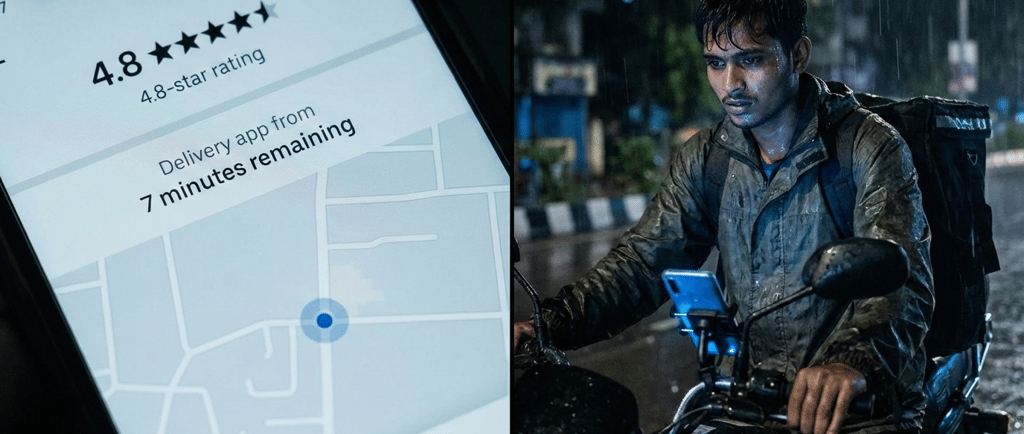
The gig economy runs on distrust. That’s the real issue.
On New Year’s Day 2026, Deepinder Goyal, co-founder of Zomato, posted on X that his platforms had delivered 7.5 million orders the previous night, “largely unaffected” by a nationwide strike of over 200,000 gig workers. He added: “If a system were fundamentally unfair, it would not consistently attract and retain so many people who choose to work within it.”
The Telangana Gig and Platform Workers Union replied: “7.5 million orders were delivered because workers cannot afford to log out, not because the system treats them justly.”
This exchange sums up the gig economy. The CEO sees people choosing to work. The workers feel trapped.
Both describe the same system, but only one tells the truth. Which one is it?
The Real Problem: Nobody Trusts Anybody
I’ve written before about how trust is the hidden foundation of successful societies. In places with high trust, people do business easily. In low-trust places, every deal comes with doubt and extra costs.
The gig economy stands as proof of this distrust.
Platforms do not trust workers to be productive, so they deploy algorithmic surveillance. Workers do not trust platforms to pay fairly, so they monitor every rupee. Customers do not trust delivery times, so they track every movement on a map. Workers do not trust customers not to file false complaints. Customers do not trust workers not to steal or harass. Women workers entering strangers’ homes cannot trust that they will be safe. The law does not trust gig workers enough to call them employees.
The whole system expects the worst from everyone. When a system is built on distrust, it leads to exploitation. If you don’t trust someone, you don’t invest in them; you just take what you can.
High-trust employment relationships look different. Fixed wages. Reasonable hours. Job security. The employer invests in the worker’s skills. The worker invests in the organisation’s success. Both have stakes in a shared future.
The gig economy removes all of these things. Every job is short-term. Every worker can be replaced. Every action is watched. Platforms call this “flexibility,” but for workers, it means insecurity.
“Partner” Is a Legal Shield, Not a Relationship
The language gives away the game.
“Delivery Partner.” Not an employee. Not a worker. Partner.
“Aggregator.” Not an employer. Just a digital intermediary.
“Independent Contractor.” Not dependent. Not vulnerable. Independent.
If you are a partner, the company owes you nothing: no minimum wage, no provident fund, no ESI, no gratuity, no paid leave. If you are an employee, you have rights. The vocabulary is chosen precisely to take away those rights.
The Social Security Code 2020, which finally came into effect in November 2025, made this evasion official. It created a new category: “gig and platform workers.” Neither employees nor traditional unorganised workers. A separate species with separate, minimal protections.
Policy researcher Ria Kasliwal told CNN what this means in practice: “What it has essentially done, mostly, is that it has just formalised the informalisation of workers.”
Unstable informal work is packaged inside a tightly controlled company structure. It’s the worst of both worlds.
Your Boss Has No Face
Workers do not report to managers. They report to algorithms. You can read more about this in an insightful piece by Indian Express journalist Soumyarendra Barik here.
The algorithm decides which orders you receive. How much you earn. Whether you are penalised for refusing a task. Whether your rating drops. Whether your account is deactivated without warning or explanation.
There is no appeal. No human to negotiate with. No transparency about how decisions are made. The code is judge, jury, and executioner.
Karnataka’s 2025 gig worker law is the only one that gives workers the right to refuse tasks without penalty. This is remarkable only because everywhere else, refusal triggers punishment. When your boss is software, you have no leverage.
Sarvesh Kumar, a 30-year-old delivery worker in Delhi, described his experience to The Quint. During heavy rainfall, his bike skidded on a waterlogged road. He fell, blacked out, and scraped his elbows and knees. He was penalised an amount equal to the value of the undelivered order.
The algorithm didn’t check if he was hurt. It never does.
Speed Kills. That’s the Business Model.
Quick commerce turned 10-minute delivery into a marketing promise. Blinkit. Zepto. Swiggy Instamart.
For customers: convenience. For workers: a race against death.
Mohammed Ayan is 19 years old. He is studying for a BBA while working part-time as a quick-commerce rider. In his first four months, he fainted on the road from heat exhaustion and crashed while rushing to meet a deadline. “The company pushes us with incentives,” he told The Week. “It makes us drive recklessly.”
After the December 2025 strikes, Labour Minister Mansukh Mandaviya intervened. On January 13, 2026, he met executives from Blinkit, Zepto, Zomato, and Swiggy. The platforms agreed to remove the “10-minute delivery” tagline from their branding.
But The Wire reported that hours after the announcement, options like “Near & Fast” with 10-15 minute windows were still live on the apps. The marketing changed. The incentive structure did not. Faster delivery still means more orders. More orders still mean more earnings. The economics remain lethal.
The platforms removed a slogan. They did not remove the pressure.
The Algorithm Doesn’t Attend Funerals
No platform has shared worker mortality data with government authorities. We do not know how many gig workers have died on the job. The companies that track every movement, every rating, every rupee, do not track deaths, or if they do, they do not disclose them.
Shaik Salauddin, founder of the Telangana Gig and Platform Workers Union, described a case to Nonprofit Quarterly. Rizwan was delivering food on his brother Khaja’s account because Khaja was ill with a fever. Rizwan died in an accident. Because he was logged in under another name, the family received nothing.
“Are the company’s management and IT systems so poor that they couldn’t recognise him?” Salauddin asked. “If they didn’t pay attention, that’s their fault.”
When a worker dies, the algorithm simply assigns the next delivery to someone else. The system does not pause. It does not mourn. It optimises.
She Enters Your Home Alone. The Law Won’t Follow.
The gig economy is not just about men on motorcycles. For women, the distrust cuts deeper.
GIPSWU (the Gig and Platform Services Workers’ Union) is India’s first union for women gig workers. Its members work primarily with Urban Company as beauticians, cleaners, and spa professionals. They go into strangers’ homes, alone, to provide intimate services. They face risks that male delivery workers do not.
In November 2024, Chandrika Goud died at 32. She had worked as a beautician with Urban Company for five years. GIPSWU alleged her health had deteriorated due to “years of relentless harassment, intimidation, and abuse.” In February 2024, she had filed a police complaint against a senior who berated her using abusive language during a quality-check call. She was a union campaigner who participated in government consultations. She had no one to turn to for herself.
“If you talk to 100 platform workers, 50 will talk about wanting to kill themselves,” said Seema Singh, a beautician and GIPSWU member. “But who do we share our problems with?”
Urban Company requires a minimum rating of 4.8 stars. Fall below, and you risk deactivation. Cancel more than two bookings a month, and you risk losing your livelihood. Workers report being sent to appointments far outside the promised 5-kilometre radius, spending hours commuting at their own expense, working 13-hour shifts on weekends without additional pay.
When workers protested, GIPSWU described the conditions as “horrific” and akin to “slavery.” Urban Company’s CEO dismissed the protests as manipulation by “local politicians and unions.”
In December 2021, Urban Company sued its own protesting women workers. After two nights outside the company’s Gurugram office, the women dispersed. They had no access to toilets. They feared for their safety after dark.
A company that sends women into strangers’ homes couldn’t even offer a toilet for its own workers outside its office.
No Workplace, No Protection
The Prevention of Sexual Harassment Act requires employers to establish Internal Complaints Committees. But platforms say they are not employers. Their workers are “partners.” The law, they argue, does not apply.
In 2024, the Karnataka High Court disagreed. In Ms (X) vs. the Internal Complaints Committee, ANI Technologies Private Limited, a passenger complained about an Ola driver. Ola argued the driver was not an employee. The court ruled otherwise: for PoSH purposes, platform workers can be treated as employees.
But that decision protects passengers, not workers. If a client harasses a beautician at their home, she has nowhere to turn. The client isn’t a platform employee, and neither is she. There’s no official workplace. Legal action needs proof, but how do you prove something happened in a place that doesn’t officially exist?
GIPSWU has demanded that PoSH explicitly cover platform workers. They demanded that the Local Complaints Committees receive training for platform-specific cases; that the platforms mandate safety protocols for both workers and customers.
None of these demands has been met.
The Law Exists. Enforcement Doesn’t.
Some states have moved. Credit where it is due.
Rajasthan passed India’s first gig worker welfare law in 2023, including registration, a welfare board, and a social security fund. Karnataka’s 2025 law is the most comprehensive: a 1-5% welfare fee on transactions, the right to refuse tasks, transparent contracts, requirements for algorithm disclosure, and anti-discrimination provisions. Bihar and Jharkhand followed in 2025. Telangana has a draft bill pending.
The central government notified the four Labour Codes in November 2025, six years after Parliament passed them. Gig workers finally have legal recognition. The Social Security Code provides for a central fund covering life insurance, disability, health, maternity, and old-age protection.
But what’s written in the law doesn’t always happen in real life.
The e-Shram portal, set up to register unorganised workers, had only 512,000 platform workers signed up by late 2025. But there may be 10 to 20 million gig workers. The draft rules from December 2025 state that you must work 90 days on a single platform or 120 days across multiple platforms to qualify for benefits. This intentionally leaves millions out.
Ambika Tandon, a Cambridge researcher affiliated with the Centre of Indian Trade Unions, told TechCrunch that the law ignores what workers actually care about: “fluctuating earnings, account suspensions, and sudden termination of accounts.”
The e-Shram portal gives insurance, but workers mostly want to know why their accounts get blocked without any reason.
The Fixes Are Obvious. The Will Is Missing.
Minimum hourly wages, not ₹5 per delivery. Algorithm transparency, not black-box deactivations. Portable benefits that follow workers across platforms. Union recognition. Delivery timelines that do not require breaking traffic laws. Paid rest breaks. Insurance that actually pays without bureaucratic obstacles.
None of these changes are hard to make. They just cost money. The same money that currently flows unchecked into the pockets of investors and founders.
Zomato’s market capitalisation: $28 billion. Swiggy’s: $11 billion. Urban Company turned profitable before tax in April 2024 and launched an IPO in September 2025. Its founders held roughly 20% of a company valued at $2.8 billion.
Meanwhile, Urban Company beauticians report earning ₹500-600 per day for 12-14-hour shifts. Delivery workers earn ₹5 per order. A Swiggy rider in Hyderabad works 7 PM to 5 AM every night.
These aren’t small startups struggling to survive. These are billion-dollar companies choosing not to be fair.
The government must force what the market will not deliver. Enforce the Labour Codes; not just notify them. Mandate platform-driven e-Shram registration. Set minimum hourly rates. Create fast-track grievance tribunals. Require algorithm transparency. Fund the welfare boards created by state laws.
Laws that aren’t enforced are just suggestions. Suggestions don’t put food on the table.
23 Million “Partners” and Counting
India’s gig workforce is projected to reach 23.5 million by 2030. Some estimates go higher.
This isn’t a small part of the economy. For millions of young Indians who can’t get regular jobs, gig work isn’t a choice; it’s the only option. When there are no jobs, there are gigs.
If gig work stays unfair, we’re creating an economy where millions have no security, families can’t plan, and a single illness or accident can mean poverty. In old age, there’s nothing to fall back on, and the gap between owners and workers only gets wider.
We have seen this before. It was called pre-industrial capitalism. Factory owners made the same arguments: workers are free to leave, the market sets wages, and regulation will kill jobs. It took a century of struggle, strikes, unions, legislation, and enforcement to change it.
The gig economy wants us to repeat that old story, to think that “flexibility” makes up for exploitation, and that “partnership” means everyone is equal.
But it doesn’t.
The Lie and the Question
The delivery worker who brings your biryani at 11 PM isn’t your partner. He isn’t Zomato’s partner either.
He’s someone who can’t afford to log out. His bike is on an EMI plan. His rating drops if he takes a bathroom break. He has no pension, no leave, no security, and no say.
The beautician who visits your home isn’t Urban Company’s partner. She pays to join the platform, buys her own products, and travels to far-off appointments at her own cost. She worries about being deactivated if her rating drops below 4.8. She enters your home alone, without the legal protection she deserves.
The gig economy promised freedom, but delivered a new kind of bondage controlled by algorithms, watched constantly, and unstable, all while calling it entrepreneurship.
The December 2025 strikes were about dignity, not logistics. The platforms won that round. Workers returned because they had no alternative.
But the question is still there.
Will India build an economy that works for the people who work in it? Or will we accept that 23 million Indians will spend their lives as “partners” in their own exploitation?
The answer depends on whether we recognise the lie, and if we’re willing to do something about it.