
They Trusted Strangers. We Trusted Only Our Own.
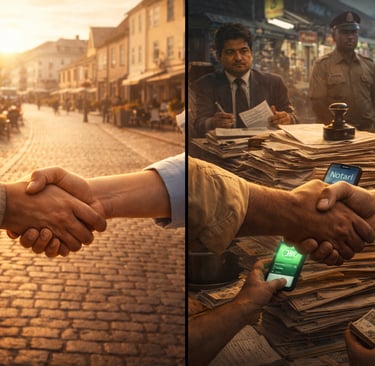
A delivery agent refused my Aadhaar card as identity proof. He needed an OTP. That six-digit number matters more than government-issued documents. This is India's trust deficit in action. It costs us trillions. And we barely notice because we've always paid it.
ECONOMYLEADERSHIPPOLITICSDEMOCRACYGOVERNANCESOCIO-ECONOMICSTRUST

Why High-Trust Societies Build Wealth, And Why India Pays The Price For Suspicion
K. Shankar called after reading my first article in the India-China series. I urged him to read the entire five-part series. Always curious and skilled in socio-economics, he made me think about how trust shapes a country's economic growth. He mentioned the Nordic countries and reminded me of the research and impact modelling we did during Chhattisgarh's assembly elections. That work showed how high-trust societies have better law and order and more prosperity, and we had strong data to back it up.
He also mentioned that high-trust communities, such as the Marwaris and the Gujaratis, prosper. He spoke about how Indian society was much better off on several SDG parameters (there might not have been any such terminology back then!) in the early 1970s. He became nostalgic remembering times from his childhood.
He encouraged me to write about this topic, and I asked if he wanted to join me, and I am glad he did. Shankar and I co-authored this article.
In Denmark, 74% of people believe most strangers can be trusted.
In India, that number hovers around 30%.
This isn't just a cultural difference. It's a major economic gap.
Algan and Cahuc calculated that if trust in India had matched Sweden's levels, our GDP per capita would be approximately double what it actually is.
Double. Not 10% higher. Not 20%. Double.
When it comes to socio-economic development, we focus on land reform, labour codes, and logistics costs. We praise single-window clearances, even though they still mean many visits. But we often overlook the invisible foundation of a working economy: the belief that most people will keep their word.
The Economics of Suspicion
A lack of trust makes every transaction more expensive.
If you trust your supplier, you don't need a 40-page contract. If you trust your employee, you don't need surveillance. If you trust your government, you don't need bribes for basic services. If your government trusts you, you don't need to spend hours standing in serpentine lines. If you trust your courts, you don't avoid formal agreements entirely.
Karan Avtar Singh sir mentioned during my call with him on a late Saturday afternoon, Francis Fukuyama’s 1995 book, Trust. He read a few lines from it and shared his wisdom that Francis Fukuyama argued that high-trust societies like Japan, South Korea, and Germany could build large organisations that go beyond family ties. Low-trust societies stayed limited to family businesses, unable to grow, professionalise, or compete.
Knack and Keefer showed this across 29 market economies: societies that trust strangers invest more, save more, and innovate more. In places with low trust, businesses spend money on lawyers instead of engineers. They invest in security instead of growth. They keep their companies small because they can't trust outsiders with real responsibility.
Zak and Knack's model predicted, and data confirmed, that very low-trust societies get stuck in poverty. The cost of checking everything pushes out investment. The informal economy grows because formal contracts can't be enforced.
This isn't just theory. It's what we see everywhere around us.
The Nordic Advantage
Denmark leads the world with 74% interpersonal trust. Norway follows at 72%, Finland at 68%, and Sweden between 62% and 83%. The global average is 30%.
The economic outcomes are proportionate. Norway's GDP per capita exceeds $105,000. Denmark's is $76,000. India's is around $2,500.
Did the welfare state create trust, or did trust enable the welfare state?
The evidence is decisive. Bjørnskov and Bergh found that trust levels among Scandinavian descendants who emigrated 70 to 150 years ago remain high, even though they never experienced Nordic welfare systems. As the researchers concluded: "We've always had great trust in other people in Scandinavia, and this trust is the cornerstone of our welfare state."
Universal welfare depends on believing that people who receive help truly need it. When people trust this, they support sharing resources. When they don't, strict checks follow, and the system falls into mutual suspicion.
Historical factors explain the Nordic advantage. The Lutheran Reformation created more accountable religious institutions. Sweden passed the world's first freedom of information law in 1766. Nineteenth-century mass education built social cohesion.
Can India do the same? Not quickly. But the process matters. Trust isn't something you're born with. It's built by institutions, through fair and consistent treatment by the state over many years.
It's Not About Democracy Versus Authoritarianism
Trust empowers nations. China reached SDG-equivalent parameters in the early 1990s that India is only achieving now. A 30-year gap. And this has nothing to do with democracy versus authoritarianism. The Nordic democracies outperform everyone.
Japan's post-war miracle was built on trust extended beyond family to corporations, institutions, and the state.
The keiretsu system showed this in action. Toyota's supplier network includes 200 partners who solve problems together rather than negotiate against each other. The Just-in-Time system needs complete trust. Parts arrive just hours before they're needed, with no backup. If one supplier fails, the whole line stops. This simply cannot work where trust is low.
This system created 9.6% annual growth from 1952 to 1971.
Then Fukushima happened.
Government communication was delayed and incomplete. The first radiation map appeared seven months after the accident. Trust in officials dropped 58 points. Corporate scandals made things worse. Olympus concealed $1.7 billion in losses. Toshiba overstated earnings with 98 executives engaged in fraud.
Today, Japan ranks as the least trusting nation globally on the Edelman Trust Barometer, with an overall score of 37.
The lesson is clear. High trust can fall apart in just a decade if you fail to communicate promptly, and as a result, your institutions fail. When that happens, economies built on trust become fragile.
India's Trust Deficit
India is not a high-trust society.
The World Values Survey shows 30 to 35% of Indians say "most people can be trusted." The 2025 Pew survey found that a majority say most people cannot be trusted.
The Edelman Trust Barometer 2025 surprisingly ranks India third in the world. But this hides a 15-point gap between high-income Indians (80%) and low-income Indians (65%). The survey mainly includes urban, educated people who benefit from working institutions. For those who deal with the state through ration shops, tehsil offices, and police stations, things are different.
Only 28% have "great trust" in the Election Commission. That's down from over 50% in 2019. Trust in police stands at 65% nationally, but less than 10% in Uttar Pradesh and Punjab.
The colonial legacy explains much. The 1861 Police Act, which still governs Indian policing, drew on the Irish Constabulary model designed for suppression. British authorities deliberately cultivated fear of the police when they ruled India with an iron fist. They revised their police act a few decades ago, and since then, trust in the system and incentives for incumbents have increased. India continues with the archaic system. The template persists 79 years after independence, and the new brown sahibs continue to enjoy the colonial legacy of a police state.
Caste creates strong trust within groups but weakens trust between groups. Religious divisions make this worse. 66% of Hindus see themselves as "very different" from Muslims, and Muslims reciprocate the feelings. This is in-group trust. It doesn't bring the economic benefits of trusting strangers.
The costs show up in India's massive informal economy. Approximately 45% of GDP in FY 2024-25 comes from the informal sector, with over 90% of the workforce employed informally. Payment fraud costs ₹75 to 100 crores daily. Cash-on-delivery persists despite India's digital payment revolution. Buyers, sellers, and delivery agents don't trust each other.
We have become a country where everything depends on an OTP, even for a simple delivery.
Recently, a "delivery partner" threatened to take back my package because their system wasn't working and couldn't send an OTP to my phone. I showed him my Aadhaar card and driving licence. Just like Shri Gyanesh Kumar, he wouldn't accept them as proof of my identity. After several calls to their call centre, the system finally sent the all-important six-digit number to confirm that I was indeed me! Writing this incident reminded me of this brilliant song from the movie Daddy. Enjoy!
This is the trust tax. We all pay it. Every transaction. Every day.
The States That Prove The Thesis
India's federal structure provides a natural experiment. The pattern is stark.
Goa and Sikkim lead in per capita income. Goa stands at approximately ₹3.57 lakh (around $4,250) and Sikkim at ₹3.39 lakh (around $4,035). Both are roughly three times the national average of ₹1.14 lakh (around $1,357). These are small states with focused administration and community cohesion. Murder rates are among the lowest. Conviction rates are among the highest.
Kerala has India's highest HDI (0.779), highest literacy (96.2%), and conviction rates around 89%.
Tamil Nadu demonstrates institutional strength, driving industrial development. Power alternates between DMK and AIADMK, but core developmental policies remain stable. This predictability creates investor confidence.
Gujarat is more complex. It ranks as a Top Achiever in Ease of Doing Business and led the Good Governance Index in 2021. It attracted $2.39 billion in FDI in the first half of FY 2025-26. Violent crime rates are nearly half the national average. But LSE analysis found Gujarat's growth acceleration occurred in the early 1990s, and HDI performance relative to the national average actually worsened during the 2000s. Gujarat ranks 21st in HDI despite a high per capita income.
Gujarat's success comes from its people. It is a high-trust mercantile society built and maintained by traders across geographies and centuries. It has been an enterprising state since the beginning. Combine this with pro-business policies and efficient regulations, and you get institutional trust. Predictable policies. Efficient bureaucracy. All fuelled by trust between people. The lesson is the same everywhere: trust among people and working institutions builds confidence, and confidence brings investment.
The Northeast shows community trust compensating for weak state capacity. Mizoram has 92% literacy and a 95% conviction rate, the highest in India. The Young Mizo Association helps with strong local governance. High trust within the community allows for effective local rule. But limited trust in outsiders makes wider integration harder.
Bihar: The Low-Trust Trap
If any single case validates the thesis, it is Bihar.
Per capita income of ₹76,490. Among the lowest nationally. SDG Index score of 57. The worst performer. CareEdge State Ranking 2025 composite score of 34.8. The lowest among large states.
The "Jungle Raj" period under Lalu Prasad Yadav (1990 to 2005) institutionalised criminality and demolished trust amongst people on a massive scale. At the time, The Economist described Bihar as "a byword for the worst of India: corrupt politicians indistinguishable from mafia dons, caste-ridden social order, chronic misrule that allowed infrastructure to crumble."
The extortion industry decimated business. Medium and small enterprises closed and shifted to other states.
Crime surged 80.2% between 2005 and 2024. The police-population ratio stands at 81 per 100,000. That is the worst in India. One officer for every 1,227 people. Over 5 million court cases remain pending.
An estimated 4.4 to 5 million labour migrants work in other states. Bihar's economy has become a "remittance economy." 52% of rural households report that remittances contribute more than half of their income. The state exports human capital educated at subsidised rates and imports remittances.
Nitish Kumar's post-2005 governance showed some improvement. Bihar's conviction rate has risen to approximately 52%, shedding its historic "bottom performer" tag. But a 2025 white paper declares "the promise of good governance remains largely unfulfilled," with crime rates increasing every year since 2015.
Law and Order: The Foundation
These examples show that trust needs enforcement. Not for every transaction, but for the real threat that breaking the rules will have consequences.
A 1% increase in homicide rates leads to a 0.25% decrease in economic growth. Crime costs India approximately 6% of its GDP annually.
Police capacity varies dramatically. The national average stands at 155 per 100,000, compared with the UN-recommended 222. Nagaland has 1,136. Bihar has 81.
The national average conviction rate for IPC crimes is projected to reach 60.2% for 2025. Top performers include Mizoram (98%), Delhi (89%), and Kerala (87%). The lowest are Himachal Pradesh (16%), Andhra Pradesh (32%), and Assam (36%).
India has over 50 million pending cases. Judicial delays cost more than 2% of GDP annually. Contract enforcement takes approximately 4 years. In Singapore, it takes 164 days.
When contracts cannot be enforced, businesses depend on personal networks. When disputes take years to settle, investors avoid making long-term plans.
Can Trust Be Built?
This leads to a valid question. Can trust be built?
If trust is purely cultural, India's prospects are bleak. If it can be engineered through policy, there is hope.
Both ideas are partly true. Deep social trust takes generations to build. Trust in institutions can grow more quickly.
Education affects trust, but it depends on the situation. In countries with high corruption, more education can actually lower trust because people see more of the problems. In India, simply expanding education won't build trust unless institutions improve as well.
Government transparency helps. The RTI Act generated over 17.5 million applications in its first decade, uncovering discrepancies in food distribution, scholarships, and land rights. Now it is clearly under threat.
Universal welfare builds trust better than targeted programmes. Jan Dhan Yojana brought 310 million Indians into formal banking without making anyone feel singled out. Newer schemes (Ladli Behena, etc.) that give cash only to certain groups are less likely to help. They will erode trust in society.
Digital infrastructure offers India's most promising quick win. UPI handles over 18.39 billion transactions monthly. That is 85% of all digital payments. India accounts for 49% of global real-time payment transactions. Built as a public goods with zero transaction fees, it has empowered street vendors, small businesses, and migrant workers.
Bank accounts increased from 400 million in 2014 to over 2.5 billion in 2025. The Financial Inclusion Index improved from 43.4 in 2017 to 67.0 in 2025. The gender gap in financial inclusion has disappeared.
When a system works every time, people start trusting the system, not just other people. When the paanwala's payment arrives instantly. When the Viksit Bharat Gramin Rozgar Yojana (VB G RAM G) wage comes on time. When subsidies transfer without leakage. That is when trust grows.
What Must Change
Now, I am sure you will ask us: what must change? Let us tell you.
Judicial reform is the highest-leverage intervention. Fifty million pending cases cost 2% of GDP annually. Fill the 33% High Court and 21% District Court vacancies. Move toward 50 judges per million from the current 15. Expand e-courts. Create specialised commercial courts.
Police reform requires addressing the colonial legacy. The 1861 Police Act still governs Indian policing. Bihar's 81 officers per 100,000 is untenable. Insulate police from political interference. Reorient training from control to service.
The focus should be on improving law and order, supplemented by sustained governance with a clear carrot-and-stick policy. Any serious threat to law and order should be met with suitable punishment. At the same time, the honesty of citizens should be rewarded handsomely.
Extend the UPI model. Land records, property registration, and business licensing. Each domain offers an opportunity for transparent, instantaneous, corruption-free transactions.
State-level governance reform offers immediate gains. What Tamil Nadu, Gujarat, and Karnataka have achieved is replicable. When businesses and migrants vote with their feet, lagging states feel the pressure.
Deep social trust takes generations. Nordic advantages reflect centuries of institutional development.
But some changes bring faster results. UPI changed payments in just eight years. State-level reforms showed real progress within a few election cycles. The best approach is to mix quick wins with long-term investments in institutions.
This isn't easy for politicians who think in five-year terms from election to election. They don't have any incentive to think long-term. We need to make them accountable to the public and stop them from draining our hard-earned money from the exchequer without any serious consequences. It calls for steady effort over flashy new ideas, fairness over favouritism, and predictability over big gestures.
The Cost of Inaction
The cost of inaction is very high.
If trust in India had matched Sweden's levels, our GDP per capita would be approximately double.
Even if that estimate is only half right, the lack of trust costs us trillions in lost growth.
Every informal transaction evading taxation. Every investment going to Vietnam. Every skilled graduate emigrating. Every entrepreneur staying small. Every contract that cannot be enforced. Every dispute taking five years to resolve.
This is called the trust tax.
We pay it daily. We barely notice because we've always paid it.
Other countries don't pay it. Or they pay much less. Over time, that difference compounds. It creates the gap between Bihar and Bavaria. Between Jharkhand and Japan. Between the India we have and the India we could become.
Trust is infrastructure. Invisible. Intangible. But as essential as roads, ports, and power are.
We can keep ignoring it. Or we can start building it.
The choice, as always, is ours.