
The Machine That Meets Every Evening.
The Rashtriya Swayamsevak Sangh runs approximately 88,000 daily gathering points across India. It has done so for one hundred years. No other political formation in India, or any democracy, has an infrastructure of this depth. Part two of the Invisible Machines series maps the voluntary machine that outlasts every government.
POLITICAL COMMUNICATIONSOFT POWERPOLITICAL INFRASTRUCTUREBJPPOLITICSINVISIBLE MACHINESTHE INVISIBLE MACHINES SERIESPOLITICAL STRATEGYRSSCULTURAL STRATEGY
This is the second part of a six-part series on the invisible machines of Indian democracy.
Part one of this series made a structural distinction. I explained that Indian democracy depends on two parallel machines. One is voluntary and continues to run no matter which party is in power. The state funds the other and tends to disappear when governments change. At the national level, only the BJP currently operates both machines.
This section looks at the voluntary machine.
I am not writing as a supporter or a critic, but as someone who has studied this structure for more than ten years. I will explain what it is, how it works, what it has built, and why there is nothing quite like it on the non-BJP side of Indian politics. You can draw your own conclusions. My aim is simple: before debating whether the Rashtriya Swayamsevak Sangh is good or bad for India, it is first important to understand what the RSS actually is as an organisation. Most political commentary in India skips this step.
I also want to avoid a common mistake. Non-supporters often call the RSS a conspiracy, while supporters see it as a spiritual family. Neither view fully captures what it is. At its core, the RSS is an infrastructure organisation. Infrastructure does not need to be loved or feared, but it does need to be understood.
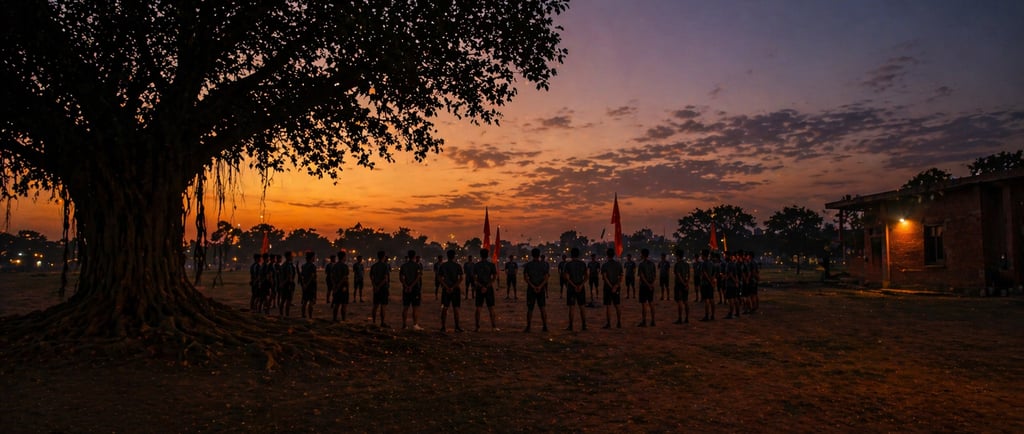
Let’s start with what happens every evening around six o’clock on about 88,000 grounds across India.
The basic unit
A shakha is an hour-long gathering at an open ground. Men and boys assemble, perform physical exercises, play games, sing songs, and listen to a short talk on patriotism, culture, or current affairs. There is no formal enrolment. Whoever turns up becomes a swayamsevak. A Mukhya Shikshak leads the session. A Karyavah handles administration. Smaller groups within the shakha have their own leaders, called Gatanayaks. Women are not admitted. A parallel women’s organisation, the Rashtra Sevika Samiti, founded in 1936 by Lakshmibai Kelkar, runs its own shakha network.
This description sounds ordinary. The sociological significance lies in the word ‘daily.’
The RSS shakha meets every evening, no matter what. It gathers whether or not there is an election, whether the BJP is in government or in opposition. It continues through scandals, court cases, leadership changes, and even national emergencies. This structure has kept meeting for a hundred years.
Think about how deep this format goes. The Communist Party of India (Marxist) runs party branches that meet weekly at best, and often only monthly. The Dravida Munnetra Kazhagam has district committees that meet from time to time. The Trinamool Congress activates its booth committees mainly during elections. The Indian National Congress has mandal and block committees, but these mostly exist on paper between elections. No other group in Indian politics meets daily at this scale across states and uninterrupted for decades.
This is the first key fact about the voluntary machine: it is not just for elections. It is a permanent part of society that also shapes political outcomes.
The current count, reported by RSS itself at the Akhil Bharatiya Pratinidhi Sabha (ABPS) held at Samalkha between 13 and 15 March 2026, is 88,939 shakhas across 55,683 locations, coordinated through 59,004 mandals. Growth has been sharp in the last decade. In 2010, there were approximately 39,000 shakhas. By 2020, around 70,000. The pandemic disrupted 2021. The last year alone added over ten thousand. The stated centenary target was one lakh shakhas by the end of 2025. As of early 2026, they are close.
The fact that the number can grow by ten thousand in a single year says a lot. This is not just natural growth; it is organised recruitment. Targets are set and met.
What Samalkha actually was
Let’s pause to look at Samalkha. The March 2026 ABPS meeting there shows more about how this machine works today than any outside analysis could.
A total of 1,438 representatives from 46 provinces gathered for three days. What they shared was not just a theory of expansion, but real numbers from the field.
Through the Griha Sampark Abhiyan, the household contact programme conducted in the year running up to the centenary, the RSS had made direct household contact with 10,02,12,162 citizens. Ten crore two lakh. Across 3,89,465 locations. These were not rally attendees. These were documented home-by-home contact points. A pracharak or swayamsevak at the door, a conversation with the family, a record kept.
Hindu Sammelans, meaning community gatherings framed in explicitly religious-cultural terms, numbered 37,048 programmes across 37 of the 46 provinces. 3.49 crore participants total. Of these, 1.93 crore were men and 1.56 crore were women. Let that ratio sit for a second. Women in such large numbers thronging to these events is not what anyone expects of RSS-adjacent gatherings. The Hindu Sammelan model has evolved specifically to draw women into the voluntary machine through religious and cultural entry points rather than through the male-only shakha format.
At the provincial level, the numbers become more concrete. Uttar Assam province alone reported 11.15 lakh families contacted, 13,061 villages covered, 16,940 karyakartas from 2,028 mandals participating. Its 1,128 Hindu Sammelans reached 6.40 lakh participants across 7,570 villages. In Uttar Assam too, women participants exceeded men: 4.10 lakh women against 2.30 lakh men.
All of this was already in place before the Election Commission announced the five-state election schedule on 15 March. This was before any manifesto, slogan, or candidate list. The campaign that most political analysts will discuss in April 2026 had, in its invisible form, been running through all 13,061 Assam villages for a full year before that.
The Samalkha ABPS also announced an organisational restructuring. The RSS has operated in 11 Kshetras, or zones, for decades. This framework is being replaced with a new structure, details of which are being rolled out through 2026.
Restructuring an organisation as slow to change as the RSS on this scale is not routine. The centenary has become the moment for the deepest internal changes the Sangh has tried in a generation.
This is what I mean when I say the machine is not just looking back at its past. It is getting ready for the future.
The training machine
Behind the shakha is a training pipeline. This is where the voluntary machine stands out most clearly from anything else in Indian political life.
At the base, swayamsevaks. At the next level, karyakartas, the active functionaries who have completed formal training at Sangh Shiksha Varg camps. The training has four stages: a primary camp of seven days, a first-year camp of twenty days, a second-year camp of twenty days, and a third-year Officers’ Training Camp of twenty-five days, held at Nagpur. Completing all four makes one a fully trained karyakarta eligible for senior positions.
About 95 per cent of karyakartas are grihasthas, householders. These are men with jobs, families, mortgages, and children in school, who give their time to the organisation outside of work hours. The other 5 per cent are pracharaks, who work full-time. They take a lifelong vow of celibacy, do not marry, and do not keep personal income. The organisation supports them.
This category matters most for understanding how the RSS exercises operational control across its ecosystem. A pracharak can be deputed. The Sangh can send him to serve within an affiliated organisation for a specified period: five years within Vidya Bharati, managing the education network; three years within the Bharatiya Janata Party’s organisational wing; two years within the Vishwa Hindu Parishad. A pracharak is a cadre whose primary loyalty is to the RSS, not to the organisation in which he currently works.
This is why deputed pracharaks almost always fill the BJP’s top organisational posts at both national and state levels. The BJP General Secretary (Organisation) at the national level, and the same post in every state, is held by a pracharak. This is how the RSS coordinates the Sangh Parivar, not by issuing commands from Nagpur, but by quietly placing people whose lifelong loyalty is to the idea that created the party, not just the party itself.
Narendra Modi was a pracharak before he entered electoral politics. So was Atal Bihari Vajpayee. So were L K Advani, Murli Manohar Joshi, and many state Chief Ministers across the decades. The pracharak route is the shortest path from ideological formation to political power that Indian politics contains.
The closest comparison is the Communist Party’s whole-timer system in Kerala. A CPI(M) whole-timer is also full-time, modestly paid, and committed to the ideology for life. Former Kerala Chief Minister V S Achuthanandan and E M S Namboodiripad were both whole-timers. But the CPI(M) whole-timer system is part of a single political party. They cannot be sent across a network of 32 affiliated organisations, because such a network does not exist. In contrast, the RSS pracharak system acts as the nervous system of a federation.
The affiliate network
The RSS publicly recognise around thirty-two formally affiliated organisations. A team of researchers working under the guidance of Dr Felix Pal, lecturer in political science and international relations at the University of Western Australia, tried to map out the full network of RSS and has documented over 2,500 organisations. The collective name is the Sangh Parivar.
I want to walk through the structure of this Parivar, not as a critic or a devotee, but as someone mapping its infrastructure. Let’s try to look at what the RSS ecosystem actually includes that impacts your day-to-day life.
Student and youth organisations: The Akhil Bharatiya Vidyarthi Parishad, founded in 1948, has more than five million members. It is the largest student organisation in the world. Its alumni include Amit Shah, who has publicly described himself as an organic product of ABVP, and more than a dozen ministers in the current Modi government. In September 2025, ABVP captured the Delhi University Students’ Union and the Hyderabad Central University union. It is active on over five hundred campuses. The Bharatiya Janata Yuva Morcha, the BJP’s youth wing, absorbs ABVP alumni who move into electoral politics.
Women’s organisations: The Rashtra Sevika Samiti, founded in 1936. The Durga Vahini, founded in 1991 as the VHP’s women’s wing. The Matri Shakti, a newer formation. These operate their own shakha networks, their own training camps, their own federations.
Labour organisation: The Bharatiya Mazdoor Sangh, founded in 1955. It has over ten million members, making it the largest single trade union in India. It opposes pro-corporate policies. It advocates Swadeshi economics. When the Modi government’s labour code reforms and disinvestment moves have produced ideological friction within the Sangh, BMS has been the vehicle through which that friction has surfaced.
Farmer organisation: This is the category most often overlooked in commentary about the Sangh. The Bharatiya Kisan Sangh was founded in 1979 by Dattopant Thengadi, who had also founded the BMS twenty-four years earlier. It claims over fifteen lakh members. Historically, it has been less active in the public sphere than BMS or the Left-affiliated All India Kisan Sabha, but this lower profile is tactical, not structural. When the three farm laws were passed in 2020, and the Samyukta Kisan Morcha brought together over four hundred farmer unions in the year-long protest that eventually forced repeal in November 2021, the BKS did not join the Morcha. It supported the government’s position through the protest. After the repeal, its position shifted. BKS has since become critical of the government’s position on the minimum support price. In a federation this large, the farmer wing is allowed the space to criticise without breaking ranks because the underlying coordination infrastructure is strong enough to absorb internal dissent. This is what institutional depth looks like.
Religious and cultural organisations: The Vishwa Hindu Parishad, founded in 1964. Present in forty-five Indian provinces and twenty-nine countries abroad. Bajrang Dal, its youth wing founded in 1984 during the Ram Janmabhoomi movement. Dharm Jagran Samiti for reconversion activities. Bhartiya Gau Raksha Dal for cow protection. Hindu Jagarana Vedike, Rashtriya Sikh Sangat, Bhartiya Baudh Sangh, and Muslim Rashtriya Manch, each oriented toward a specific community. Hindu Munnani in Tamil Nadu.
Service and development organisations: Sewa Bharati runs approximately 35,000 welfare projects nationwide, spanning education, health, social welfare, and self-reliance. During the 2015 Chennai floods, 5,900 Seva Bharati volunteers conducted a massive relief operation, distributing 1.2 million food packets. During COVID-19, 2.10 lakh cadres were mobilised for food distribution, mask production, and medicine delivery. Virat Kohli publicly acknowledged the work. The Vanavasi Kalyan Ashram, founded in 1952, operates in 312 districts focused on tribal populations.
Educational organisations: Vidya Bharati runs more than 12,000 formal schools and over 24,000 institutions in total, including non-formal centres. Student enrolment is in the range of 34-39 lakh. The teacher count is approximately 1.41 lakh. The Education Minister, Dharmendra Pradhan, has publicly described Vidya Bharati as a reference point in shaping the National Education Policy of 2020. Ekal Vidyalaya Foundation runs 1,02,753 single-teacher schools in remote tribal and rural villages. Each Ekal Vidyalaya typically has 30 to 40 students. The annual cost per school is about ₹20,000.
Intellectual organisations: Vivekananda Kendra. India Policy Foundation. Bharatiya Vichara Kendra. Hindu Vivek Kendra. The Deendayal Research Institute. India Foundation, associated with NSA Ajit Doval’s son Shaurya Doval and Ram Madhav, operates as a think tank that is adjacent to, rather than formally part of, the Sangh. Vivekananda International Foundation sits in the same quadrant.
Media organisations: Organiser, the English weekly. Panchjanya, the Hindi weekly. Hindustan Samachar, the multilingual news agency. Suruchi Prakashan, the publisher. Vishwa Samvad Kendra, the communications wing. Sudarshan News, an aligned television channel.
Cooperative organisation: Sahakar Bharati.
Economic and professional organisations: Swadeshi Jagaran Manch. Bharat Vikas Parishad. Laghu Udyog Bharati for small industries. Adhivakta Parishad for Lawyers, which recently came into the limelight when AAP convener Arvind Kejriwal referred the organisation to present his argument for the recusal of Justice Swarnakanta Sharma from his case.
And then the overseas wing: The Hindu Swayamsevak Sangh (HSS) operates in more than forty countries. Its motto is the same as the parent: Sanskaar, Sewa, Sangathan. Values, service, organisation. Singapore’s Vivekananda Sewa Sangh. Malaysia’s Hindu Sewa Sangam. The United States, where HSS has its largest presence outside India, co-mobilising with VHP of America, Hindu American Foundation, and Sewa International. The stadium events in Houston in 2019 and in New York in later years were organised through these networks, not directly by the BJP.
There are many more, and if I kept listing them, this blog would never end. These groups include doctors, CAs, teachers, and professionals from all backgrounds.
I have laid this out in one unbroken list for a reason. No other political or social formation in India commands infrastructure on this breadth: labour, farmers, tribal, women, students, religious, educational, service, economic, intellectual, cultural, media, and diaspora. All have dedicated organisations. All are coordinated through the pracharak deputation. All are funded through a mix of fees, voluntary donations, diaspora remittances, and service revenues rather than a single dependency on state patronage or electoral bonds.
One development worth flagging here. In 2024, the Government of India lifted a 58-year-old ban on government servants being Swaymsevaks of the RSS. From 1966 until 2024, IAS, IPS, IFS, and other Group A officers were prohibited from being RSS Swayamsevaks under service rules. The original logic was straightforward. Civil service neutrality required formal separation from any voluntary organisation with explicit ideological commitments. The ban removal in 2024 marks a new chapter. What was previously mere alignment becomes loyal membership.
This is what large-scale infrastructure looks like in practice.
The educational long game
Let’s take a closer look at one part of this network: education.
Approximately 1,25,000 educational institutions across India are ideologically aligned with the RSS ecosystem. A child entering a Saraswati Shishu Mandir at age five follows a curriculum shaped by Vidya Bharati’s pedagogical framework through age seventeen. The same child may enter ABVP at university, become a swayamsevak at twenty-one, a full pracharak by thirty, a senior BJP organisational office-bearer by forty-five, and a minister by fifty-five.
This pipeline stretches over thirty-five years. It does not have to reach every child, just enough in enough places to keep the ecosystem going from one generation to the next.
Consider what the opposition has equivalently. The Congress has no school chain. The Left has the Kerala Sastra Sahitya Parishad literature movement, which is intellectually rich but does not operate schools. The DMK, Trinamool Congress, and Samajwadi Party have no school chains. Caste associations run some educational institutions, but these are scattered and not federated.
When people explain the BJP’s electoral success by pointing to leadership, polarisation, or welfare schemes, they are only describing the final step of a process that begins in a primary school classroom thirty years earlier. This is what the voluntary machine achieves, not just an election, but a whole generation.
The digital overlay
For most of its history, the shakha’s voluntary machine worked through face-to-face meetings: evening gatherings, weekend camps, annual conventions, and door-to-door visits during elections. This is still the foundation.
Since around 2014, a digital overlay has been added. The BJP IT Cell is legally a party organisation, not an RSS body, but its operational architecture parallels the shakha structure it overlays. Booth-level IT teams. Mandal-level coordinators. State and national hierarchies. Amit Malviya has headed the national IT Cell since 2015.
The scale, documented across multiple investigations and by the Princeton Digital Witness Lab, is approximately 5 million WhatsApp groups coordinated by 100,000 volunteers nationwide. Uttar Pradesh alone has 163,000 IT coordinators, 1,918 mandal-level IT cell heads, and 1.7 lakh WhatsApp groups, figures from 2021 that have grown since. Rajasthan has 150,000 social media volunteers. The documented time between message origination at the Delhi headquarters and arrival at a remote booth has fallen from 40 minutes to 12 minutes, with a target of 5 minutes.
This is not a separate system. It is the same system using a new medium. The shakha teaches a swayamsevak how to organise, and the WhatsApp group lets him do it on a larger scale.
The religious interface
There is one more layer to describe, and it is often missed in analysis: the Sadhu-Sant-Guru layer.
The Vishwa Hindu Parishad serves as the ideological interface between the RSS’s disciplinary structure and ordinary Hindu religious practice. The Hindu Sant and Sanyasi class, the teachers of yoga and meditation who have built followings of millions, the gurus with ashrams and channels and stadium-filling discourses, form a layer that touches a vastly larger population than the RSS’s swayamsevaks ever could.
Three gurus illustrate this. Baba Ramdev, whose Patanjali empire combines yoga television, Ayurvedic products, and explicit political positioning. Sri Sri Ravi Shankar, whose Art of Living operates across one hundred and fifty countries and whose mediation style produces diplomatic rather than confrontational adjacency to the BJP. Sadhguru Jaggi Vasudev, whose Isha Foundation and Cauvery Calling campaigns reach an English-speaking urban constituency that the RSS itself does not penetrate easily. Add Dhirendra Krishna Shastri of Bageshwar Dham as the newest entrant, whose viral religious discourse has built a younger, more explicitly Hindutva audience in a very short time.
What makes this layer important is its legal status. A temple trust is a religious institution, not a political one. A guru who urges followers to vote for Hindu interests is exercising religious freedom, not political speech. Election Commission spending rules do not cover this kind of influence. The scale is huge. Even a one per cent conversion rate among India’s fifty crore Hindu religious practitioners would mean fifty lakh extra swing voters, coordinated by about fifty thousand gurus, none of whom show up on any election spending report.
What 2024 told us, and what 2025 corrected
This machine is not static. It has its own feedback loop. The 2024 Lok Sabha result and what happened afterwards is the clearest recent example.
The 2024 result itself was a reduced mandate. The BJP won 240 seats, down from 303 in 2019. It did not cross the majority mark of 272 on its own. The government was formed with coalition allies for the first time since 2014.
In May 2024, during the ongoing elections, then BJP President JP Nadda said in an interview that the BJP "no longer solely depends on RSS." It was a statement of organisational independence widely interpreted inside the Sangh Parivar as a claim that the BJP had outgrown its parent. What followed was not public silence.
Between June and December 2024, Mohan Bhagwat made a series of public statements that commentators read as a calibrated response. He said that the opposition is not an enemy. He called for political decorum during campaigning. He raised the Manipur crisis publicly, at a time when most BJP leaders were not speaking about it. On the question of fresh Hindu-Muslim disputes over historical mosque sites, Bhagwat said something that would have been unthinkable from an RSS chief five years earlier. He suggested that some individuals were trying to become leaders of Hindus by raising such disputes, and that this was not how the Sangh understood its mission.
These statements did not stay on the front page for long, but they had an effect. They signalled to the wider Sangh Parivar and BJP members that the campaign rhetoric of 2024 had gone too far. A course correction was required.
In August 2025, Bhagwat closed the episode with a single Hindi phrase that became widely quoted. He said there was no “Manbhed” between the RSS and the BJP, only “Matbhed.” No difference of hearts. Only differences of opinion. This was the formal reconciliation. In September 2025, a two-day BJP-RSS coordination meeting was held in Kolkata specifically for the 2026 Bengal assembly. BL Santosh from the BJP organisational wing, Samik Bhattacharya as Bengal state president, Suvendu Adhikari as Leader of Opposition, along with senior RSS functionaries, sat together and re-aligned. The centenary celebrations in October 2025 brought the BJP leadership centrally into RSS programmes.
I describe this story in detail because it clearly shows what the voluntary machine is: a federation that can handle internal disagreements without breaking apart. In this system, the political wing can assert its independence, the ideological parent can show discomfort, a public reconciliation can be arranged, and the machine can get back in sync within fifteen months. No other Indian political group has a working way to correct course like this. The Congress in 1969, when Indira Gandhi broke away, could not do it. The Left in 2008, when it left the UPA, could not do it. The AIADMK, after Jayalalitha, could not do it. The RSS and the BJP can.
This is what real durability looks like. It does not mean there are no disagreements, but that there is a system to handle them and keep going.
Why it is permanent
In my view, eight structural features explain why this machine has outlasted any other Indian political group over the past hundred years.
First, the separation of ideological and electoral functions. The RSS does not contest elections. The BJP does. When the BJP loses, the RSS continues unchanged. In 2004, when the Vajpayee government fell, the shakhas continued to meet. Between 2004 and 2014, when the Congress was in power, the shakhas continued to meet. The voluntary machine is not contingent on electoral outcomes in the way that the TMC’s booth committees are contingent on Mamata Banerjee’s continued hold on Bengal, or the DMK’s cadre is contingent on Stalin’s hold on Tamil Nadu. Durability is structurally built in.
Second, the educational pipeline I described earlier: 125,000 schools and centres, a thirty-five-year process. No one else is building something like this.
Third, the basic unit meets daily. The shakha gathers every evening. A CPI(M) branch meets weekly, a DMK committee meets from time to time, and a BJP booth is active during elections. Only the shakha is continuous.
Fourth, the pracharak deputation system: a lifelong cadre who can be sent across a network of thousands of affiliated organisations. There is no single point of failure, and the ideology is not tied to one party’s fortunes.
Fifth, the organisation is present at many levels at once: locally through the shakha, provincially through the forty-six prants, nationally through Nagpur, and globally through HSS in more than forty countries. No other Indian group operates at all these levels.
Sixth, affiliate diversity. The RSS ecosystem is active in labour, farming, tribal affairs, women’s organising, student politics, religion, education, welfare, media, economic policy, and culture; not just as ideas, but as real organisations. No opposition group has this kind of reach.
Seventh, the funding model does not depend on winning elections. Money comes from school fees, donations from service work, remittances from diaspora groups, and voluntary contributions from swayamsevaks. Even if the BJP loses an election, Vidya Bharati school fees still come in.
Eighth, as shown by events from 2024 to 2025, the structure itself allows for ideological flexibility, not just policy changes. The RSS has shifted its stance on Swadeshi economics, minority outreach, caste inclusion, and campaign tone over the years without breaking apart. The ideology is built into the structure, so individual positions can change without causing a split.
The question that remains
I want to end this piece with what I think is the most important unresolved question about this machine. It’s not a conclusion, but a question.
The machine has one vulnerability, and it is not organisational. It is ideological. The RSS ecosystem requires an ongoing sense of Hindu consolidation to sustain cadre motivation. Where regional identity is stronger than pan-Hindu identity, as it is in Tamil Nadu with the Dravidian grammar, as it is in parts of Bengal with the Bengali grammar, as it is in Keralam with the composite civic grammar that I wrote about in The Untranslatable States, the machine’s expansion runs into real ceilings. Sabarimala in 2018 showed that even in Keralam, the Left had to concede ideological ground. But the harder question is whether Hindu consolidation as the motivating ideological project can be sustained indefinitely. What happens to a machine built for mobilisation when the mobilisation logic softens?
I do not know the answer, and probably nobody does. The RSS is now in the first year of its second century. The first century was about surviving, then growing, then scaling up. The second century may bring a different challenge: can a voluntary machine this deep keep working when the ideology that drove it has either succeeded so much that it runs out of steam, or hits limits it cannot easily cross?
Part three of this series will look at three of those limits: Tamil Nadu, Bengal, and Keralam. These are states where the national voluntary machine has met regional voluntary machines of similar depth. That piece will come out in mid-May, after the 4 May verdicts are in.
Parting thoughts
If you remember just one thing from this piece, let it be this: the shakha meets every evening. For a hundred years, it has gathered daily. No other Indian political group has a structure like this.
Most political analysis in India looks at the last two weeks of a campaign. This machine is focused on the next fifty years.
These systems are not focused on any single election. What matters is which infrastructure remains after the votes are counted, and which is still there for the next election.
Part 3 arrives in mid-May.
You can read part one here: One Machine Runs on Conviction. The Other Runs on Budgets.