
The Price Hike Came First. The Explanation Came Thirteen Days Later.
On 28 February, the Strait of Hormuz closed. More than half of India's cooking gas supply was cut overnight. The government increased production by 28 per cent, arranged naval escorts, and diversified imports. It also said nothing publicly for eleven days. This is not about the energy crisis. It is about how silence turned a competent operational response into an invisible one.
TRUSTCREDIBILITYCRISISCOMMUNICATIONCRISIS COMMUNICATIONPOLITICAL STRATEGYGOVERNANCEENERGYWARLEADERSHIPNARENDRA MODI

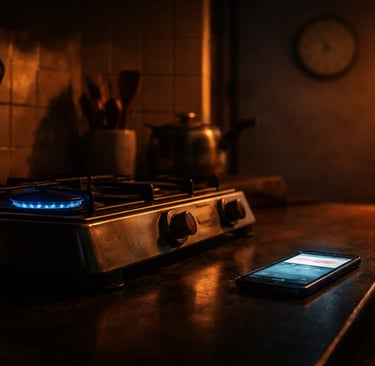
India is facing its worst energy disruption in decades. The government’s operational response has been competent. Its communication response has been a case study in how to turn a supply crisis into a crisis of trust.
Two days after Prime Minister Modi returned from his Israel trip on 26 February 2026, on 28 February 2026, the United States and Israel struck Iran. Within hours, Tehran effectively closed the Strait of Hormuz, the narrow waterway through which roughly 20 per cent of the world’s daily oil supply passes. For India, the consequences were immediate and structural: 50 per cent of its crude oil imports and nearly 90 per cent of its imported LPG travel through that strait. India imports 60 per cent of its cooking gas. The math is simple. More than half of India’s kitchens depend on a supply route that was shut overnight.
What followed over the next two weeks was a government that did many of the right things operationally and almost none of the right things communicatively. The result is an energy crisis compounded by a trust crisis, a shortage made worse by silence.
I write this not as an energy analyst but as a political communication practitioner. The supply side of this crisis is being covered extensively. The communication side is not. And in a democracy of 1.4 billion people, how you tell the story of a crisis matters as much as how you manage it.
The Thirteen-Day Timeline
Let me lay out the government’s communication response in sequence, because the sequence is the indictment.
28 February: War begins. Strait of Hormuz closes to commercial shipping. India loses access to the route through which 90 per cent of its LPG imports flow. The government says nothing publicly.
1 to 6 March: Seven days of silence. No 8:00 PM, PM address. No petroleum ministry briefing. No public acknowledgement that a ‘crisis’ is developing. During this period, tanker traffic through the strait drops from 100 to 150 vessels per day to single digits. Shell and TotalEnergies declare force majeure. Qatar halts LNG production after attacks on its facilities. The government is working internally: refineries are being directed to maximise LPG output, naval contingencies are being planned, and Russian crude alternatives are being arranged. But none of this is communicated to the public.
7 March: The government’s first public signal arrives. It is not a press conference. It is not a PM address. It is a price hike. Domestic LPG up Rs 60 per cylinder. Commercial LPG up Rs 115. This is how 33 crore Indian households learn that something is wrong. Not through an explanation. Through their monthly gas bill.
8 March: The LPG Control Order is issued, directing all refineries to maximise LPG yields and channel hydrocarbon output exclusively to the three Oil Marketing Companies. A gazette notification. No accompanying public communication explaining what it means or why it was necessary.
9 March: The government invokes the Essential Commodities Act and issues the Natural Gas (Supply Regulation) Order 2026, establishing a four-tier priority allocation system. Domestic consumers get 100 per cent. Fertiliser plants get 70 per cent. Manufacturing gets 80 per cent. This is a significant and well-designed policy intervention. It is communicated through a government order, not through a narrative that citizens can understand.
11 March: The government holds its first inter-ministerial briefing at the National Media Centre, where Dhirendra Ojha, Principal Spokesperson of the GoI and Principal Director General of Press Information Bureau, starts a briefing by saying that, “Please note that we will not take questions in today’s briefing.” Joint Secretary Sujata Sharma from the Petroleum Ministry presents data on diversified crude sourcing and production increases. It is the first substantive public communication, eleven days after the crisis began. On the same day, serpentine queues start forming outside gas agencies in Prayagraj and Moradabad. Restaurants begin shutting in Mumbai and Bengaluru. The briefing comes too late to prevent what follows.
12 March: Panic buying is now a national phenomenon. LPG bookings surge to 75.7 lakh, up from a pre-crisis average of 55.7 lakh. The petroleum ministry announces commercial LPG release to certain beneficiaries and additional kerosene allocation. Black market prices cross Rs 2,000. Modi calls Iranian President Pezeshkian, his first call to Iran since the war began. Thirteen days into a crisis that threatens the cooking gas supply of 33 crore families.
13 March: Thirteen days after the war began, LPG bookings surge to 88.8 lakh from 75.7 lakh a day earlier, and the Prime Minister makes his first public remarks on the energy crisis. The venue is the NXT Conclave at Bharat Mandapam. A business conference. His primary message: “Some people are trying to create panic and pursue their own agenda.” He does not name the opposition, but the meaning is clear. Thirteen days of governmental silence, and when the PM finally speaks, his first instinct is to blame those who filled the narrative vacuum his government created.
14 March: Petroleum Minister Hardeep Singh Puri delivers a statement in Parliament. It is detailed, data-rich, and comprehensive. He outlines production increases (28 per cent in five days), supply diversification (US, Norway, Canada, Russia), price comparisons with neighbouring countries (Rs 1,046 in Pakistan, Rs 1,242 in Sri Lanka), and consumer protection measures (PMUY beneficiaries at Rs 613 per cylinder). It is, by any measure, a competent policy response. It is also fourteen days late.
The Pattern Nobody Is Naming
If this timeline feels familiar, it should. I wrote about this exact pattern in August 2025 (“Why the Modi Government Must Urgently Reform Its Crisis Communication Strategy”). The Trump ceasefire claim: hours of silence, then contradictory statements. The Pahalgam attack: initial blame on tourists. The Bihar SIR crisis: bureaucratic language meeting public fury. Manipur: 479 days before a substantive PM comment.
The pattern is consistent across every crisis this government has faced. Operational competence undermined by communicative paralysis. The government acts, but it does not speak. And in the vacuum between action and explanation, panic fills the space. The space effectively occupied by the opposition and rumourmongers.
Consider what happened with LPG. The government increased production by 28 per cent within five days of the Control Order. It arranged Russian crude imports at 50 per cent above normal levels. It dispatched naval escorts to bring tankers through the strait. It negotiated a 2.2 million-tonne-per-annum LPG deal with the United States. It set up a three-member committee of Executive Directors from IOCL, HPCL, and BPCL to coordinate distribution. It directed state pollution control boards to permit biomass and kerosene as alternative fuels temporarily.
All of this is competent crisis management. Some of it is genuinely impressive under the circumstances. India has a 22-day LPG storage buffer, far less than its strategic petroleum reserves for crude. The government was working with a thin margin, and it managed that margin effectively.
But none of this mattered to the woman in Lakhimpur Kheri standing in a queue for a gas cylinder on 11 March. She did not know about the Control Order. She did not know about the naval escort. She did not know that production was up 28 per cent. She knew that her cylinder was not available, the price had gone up, and nobody in the government had told her why or when it would get better.
The panic buying that drove bookings from 55.7 lakh to 88.8 lakh per day was not created by the opposition, as the PM suggested. It was created by an information vacuum that the government chose not to fill for thirteen days. When people lack accurate information, they hoard. When governments do not communicate, citizens panic. This is not a political observation. It is a communication axiom.
What Should Have Happened
Let me map what a competent crisis communication response would have looked like, step by step, not as hindsight wisdom, but as a framework that any government communication team should have ready for an energy disruption of this scale.
Day One (28 February): The PM or the Petroleum Minister addresses the nation. Not a lengthy speech. A three-minute statement: “A conflict in West Asia has disrupted a critical energy shipping route. India’s cooking gas and crude oil supplies will be affected in the short term. Here is what we are doing. Here is what you should expect. Here is what we need from you.” Transparent. Direct. Before the panic starts.
Day Two to Three: The Petroleum Ministry holds daily press briefings with specific data: how much LPG is in storage, how many days of buffer remain, what alternative supply routes are being activated, and when the first shipments from non-Gulf sources will arrive. Data kills panic. Speculation fills the void left by the absence of data.
Day Four to Seven: The PM convenes an all-party meeting or addresses Parliament on the energy situation. This does two things: it signals the gravity of the crisis (which the government’s silence was denying), and it removes the opposition’s ability to politicise the issue (because they have been consulted and informed). Instead, the government’s silence gave the opposition a gift: the ability to credibly claim that the government was in denial.
Day Seven onwards: A dedicated public dashboard, online and through government media channels, showing daily LPG production, import status, distribution data, and booking timelines by state. When citizens can see the data, they do not need to hoard. When the data is hidden, hoarding is a rational behaviour.
None of this happened. Instead, the government communicated through gazette notifications, control orders, priority allocation tiers, and a Joint Secretary’s press briefing on Day eleven as part of the interministerial briefing. These are instruments of governance, not instruments of communication. They manage supply. They do not manage public anxiety.
The Suppression Reflex, Again
When the PM finally spoke on 13 March, he did not address the anxiety. He attacked it. “Some people are trying to create panic and pursue their own agenda.” This is what I called the “suppression reflex” in my analysis of Operation Sindoor’s communication failures. When the government cannot control the narrative, it attacks those who are narrating it.
During Sindoor, the suppression reflex manifested as 2,300 blocking orders, a three-hour takedown window, and 8,000 blocked X accounts. In the LPG crisis, it manifested as the PM blaming the opposition for a panic that his own silence produced, Kangana Ranaut calling criticism “an attempt to create panic,” JP Nadda accusing Congress of “not stopping politics even during difficult times,” and JD(U) MPs insisting “the opposition is misleading the nation.”
Compare this to Modi’s COVID communication. In March 2020, within days of the first lockdown, the PM addressed the nation directly. He asked people to light candles. He appeared on Mann Ki Baat. He made the crisis personal, emotional, and societal. One can debate whether the policy response was adequate, but nobody can deny that the communication response was immediate, direct, and personally led by the PM.
The LPG crisis is not on the scale of COVID. But it touches the same daily reality: the kitchen. Every household. Every meal. And yet the PM treated it as a business conference talking point rather than a national moment requiring direct communication.
The difference is instructive. COVID was a crisis the government could frame as an external attack requiring national unity. The energy crisis exposes a structural vulnerability (60 per cent import dependence for cooking gas, 90 per cent of it through a single chokepoint) that the government has not addressed in eleven years. Acknowledging the crisis means acknowledging the vulnerability. And this government does not acknowledge vulnerability. It attacks those who point to it.
The Operational Success Nobody Heard About
Here is the deepest irony. Hardeep Puri’s parliamentary statement on 14 March is one of the most competent crisis management briefings I have seen from an Indian minister. The data is specific: production up 28 per cent, refinery directives issued, naval escorts arranged, Russian crude increased 50 per cent, US LPG deal of 2.2 MTPA secured, underground cavern expansion fast-tracked at Mangaluru and Visakhapatnam, state-level coordination meetings completed across every major state, PMUY beneficiary price held at Rs 613 despite a 41 per cent increase in Saudi Contract Price.
This is serious, detailed, competent crisis management. If this briefing had been delivered on Day Two or Day Three, the trajectory of public anxiety would have been fundamentally different. People would have seen a government that was ahead of the crisis, not one that was denying it existed.
Instead, by the time Puri spoke, the narrative was already set: shortage, queues, black markets, government in denial. Restaurants had already shut. Housing societies in Goa had already issued emergency notices. Black market prices had already hit Rs 4,000. The operational success was invisible because the communication failure made it inaudible.
This is the cost of the thirteen-day silence. Not a policy failure. A communication failure that turned a competent operational response into an invisible one.
Five States, One Cylinder, Zero Narrative
Five states go to the polls in April. The LPG crisis is already campaign ammunition. The DMK has staged protests in Tamil Nadu. Opposition parties in Assam, Bengal, and Kerala are using the shortage as a rallying point. Congress has demanded Puri’s resignation. The BJP is responding with accusations of “panic-mongering” and pointing to a Congress leader caught hoarding cylinders.
All of this was avoidable. Not the crisis itself. The Strait of Hormuz closure is a geopolitical event that no Indian government could have prevented. But the political damage from the crisis was entirely avoidable through timely, transparent communication led from the top.
The lesson is not new. I have been writing it for two years. But it bears repeating because the government keeps making the same mistake.
In a crisis, the first story wins. If the government tells the story first, it controls the narrative. If the government stays silent, the opposition, social media, and panic fill the vacuum. The LPG crisis is a textbook illustration: the government’s silence between 28 February and 13 March handed the opposition a narrative that no amount of retrospective data can reclaim.
The operational response to the energy disruption caused by the war in Iran has been competent, creative, and, in some respects, genuinely impressive. The communication response has been a thirteen-day masterclass in how to convert a supply disruption into a political crisis.
The price hike came first. The explanation came thirteen days later. In between, 33 crore families were left to figure it out on their own.
That is not a communication strategy. It is the absence of one.