
The Slogan and the Shakha
India's 2026 state elections are being covered as five separate contests. They are one. Beneath the slogans that define Bengal, Tamil Nadu, Keralam, and Assam runs an invisible organisational infrastructure that has operated without interruption for a century. This piece maps both layers and asks which one prevails on 4 May.
POLITICAL COMMUNICATIONBJPWEST BENGALELECTIONSASSAMNARENDRA MODIPOLITICSBRANDINGPOLITICAL STRATEGYDEMOCRACYCONGRESSCOMMUNICATIONKERALAOPPOSITIONTAMIL NADURSSCAMPAIGN STRATEGY
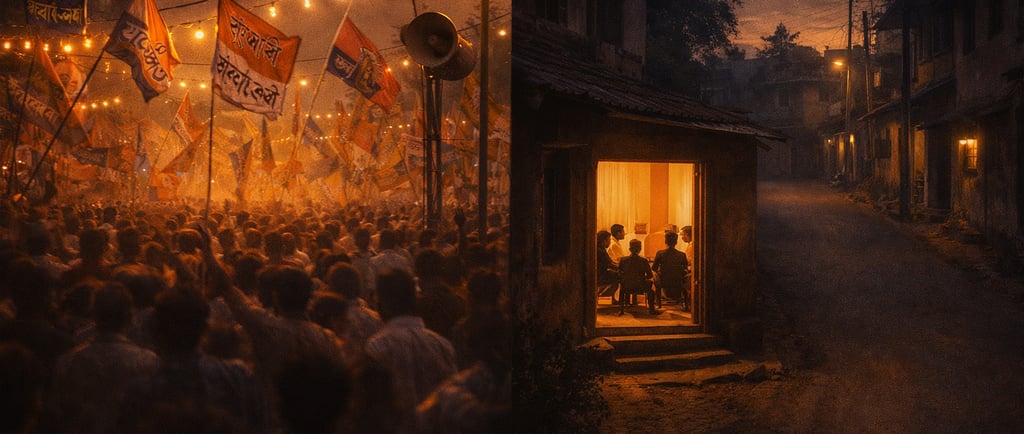
On 30 March 2026, ten days before the first phase of voting, Prime Minister Narendra Modi addressed the party workers in Assam. He did not visit the state or stand on a stage. He spoke through the NaMo App, a proprietary digital platform, in what the BJP called the "Mera Booth, Sabse Mazboot Samvaad." It was claimed that over five lakh party workers assembled at more than 4,500 shakti kendras across Assam to hear him. The Prime Minister told them that cross-border infiltration is "a matter of life and death" for Assam. Then he issued an operational directive: gather comprehensive information on encroachments in your blocks, explain their impact to the public, and share videos of victims in your area. He told them to organise "tiffin meets" in tea gardens to listen to workers and explain government schemes.
This was not a rally. It was an operational briefing, delivered simultaneously to 4,500 physical locations through a digital platform, directing booth-level workers on what to say, what evidence to collect, and how to distribute it through local networks.
Five days earlier, Rahul Gandhi had launched the Congress campaign in Keralam with a public rally at Kozhikode Beach. He addressed the gathering virtually from Delhi. He was not physically present in the state whose election campaign he was inaugurating.
That contrast is not a story about two leaders. It is a story about two fundamentally different theories of how you win power in a democracy.
One theory holds that political power flows from speaking the people's language, from building a vocabulary so native to a state that no outsider can replicate it. The other holds that power comes from being in the people's living room, from building an infrastructure so deep it does not need a local vocabulary because it is already local.
India's 2026 state elections are five simultaneous experiments in that single question. Regional incumbents are running campaigns built on linguistic authenticity, slogans that work only in one state, welfare architectures named in languages that do not translate, and political vocabularies built over decades. The BJP is running campaigns built on organisational infrastructure, an invisible machine that operates year-round, activates for elections, and functions identically whether the state speaks Bengali, Tamil, Malayalam, or Assamese.
This piece is not about who will win. It is about how these campaigns are being fought, through what channels, and why the most consequential campaign in these elections is the one you cannot see.
The Slogan
Every regional incumbent is running a campaign that works only in one state. This is not a weakness. It is the strategy.
In West Bengal, Mamata Banerjee's Trinamool Congress runs on "Jotoi koro hamla, abar jitbe Bangla," roughly "No matter how many attacks, Bengal will win again." The slogan evolved from 2021's "Bangla nijer meyekei chay" ("Bengal wants its own daughter"), which centred on Mamata personally. The 2026 version subsumes her identity into Bengal itself. Attack the TMC or Didi, and you attack Bengal. This is not new. Modi used this format in Gujarat when he was CM, fusing himself with Gujarati asmita. He then metamorphosed it into a national version: any attack on Modi or the BJP is an attack on India. The TMC has taken the same architecture and made it Bengali. Every scheme in its manifesto carries a Bengali name that is simultaneously a welfare promise and a cultural claim. Lakshmir Bhandar. Banglar Yuva-Sathi. Duare Chikitsa. The language is the campaign.
In Tamil Nadu, M.K. Stalin's DMK runs on the "Team Tamil Nadu vs Team Delhi", positioning the state election as a defence against central encroachment. With 24 alliance partners, the DMK is running the largest coalition in any state, held together not by ideology but by the shared premise that Delhi is the adversary. Stalin called his 525-promise manifesto a "superstar." Every promise is named in Tamil. Every scheme carries a Tamil title. The entire document is an assertion that Tamil Nadu's political vocabulary belongs to Tamil Nadu.
In Keralam, the LDF runs on "Mattarund LDF allathe?" ("Who else is there besides the LDF?"), an inevitability argument. Not "we delivered, reward us" but "there is no credible alternative." Pinarayi Vijayan is attempting what no Keralam Chief Minister has done in the modern era: win a third consecutive term for the Left.
In Assam, the BJP's visible vocabulary is borrowed from the national template, "Viksit Assam" (Developed Assam), backed by Orunodoi transfers and land pattas for tea garden workers. But the operational vocabulary, delivered through the NaMo App and amplified through household networks, is about "infiltration," "encroachment," and "enemies of Assam." Amit Shah's announcement that the Uniform Civil Code will be introduced in Assam if the BJP returns is the visible layer catching up to what the invisible layer has been saying for months.
Meanwhile, every challenger is being forced to answer the incumbent in the incumbent's own language.
In Bengal, the BJP has dropped "Jai Shri Ram" and adopted "Joy Maa Kali" and "Joy Maa Durga." Modi's letter to Bengal voters opened with "Jai Maa Kali." The stage at Brigade Ground was designed as a replica of the Dakshineswar Kali Temple. This is not the BJP's Hindutva speaking to Bengal. This is Hindutva learning to speak Bengali.
In Keralam, the UDF's "CJP" attack, "Communist Janata Party," accuses the CPI(M) of functioning as the BJP's proxy. Pinarayi's response: Congress is "BJP's B-team" and Rahul "lacks the political maturity expected of even a local-level functionary." Each front accuses the other of being the BJP's partner. The BJP, with no MLAs and no realistic chance of forming a government, benefits from being the axis around which both fronts destroy each other's credibility. In this context, the BJP is like a ghost: nobody has seen it, but everybody is talking about it.
In Tamil Nadu, the most closely watched experiment is not between the DMK and the AIADMK. It is Vijay's Tamilaga Vettri Kazhagam, contesting its first election solo after rejecting the NDA's reported offer of 90 seats. On 30 March, Vijay launched his campaign from Perambur in Chennai. The choice of constituency is not random. Perambur is where MGR's AIADMK first established its party roots in the 1970s. Vijay is launching from the same ground where the cinema-to-politics pipeline was built half a century ago, testing whether the model that made MGR Chief Minister can still work in the age of smartphones.
Three of these regional incumbents, Bengal, Tamil Nadu, and to a lesser extent Keralam, are running explicitly anti-Centre campaigns without coordinating with each other. The TMC, the DMK, and the LDF have independently reached the same structural argument: the Centre is the adversary. Federalism has become the regional incumbent's most effective weapon. Not ideology. Not anti-Modi rhetoric. The simpler claim: "They are coming for your state."
That is the language side of these elections. These vocabularies are powerful because they are authentic. They are limited because they do not travel.
What is operating beneath them is something else entirely.
The Shakha
On the afternoon of 15 March 2026, the Election Commission announced the election schedule in Delhi. That same afternoon, in a school ground in Nemom, Keralam, the RSS held a Hindu Ekta Sammelanam. Representatives from the Nair Service Society (NSS), Hindu Nadar Samajam, SNDP Yogam, Brahmana Sabha, and Keralam Pulayar Mahasabha attended. Retired teachers and professors were deployed for house visits in the days that followed. The visible campaign had not yet begun. The invisible campaign had been running for months.
The Nemom story goes deeper. An Onmanorama investigation published on 24 March documented that the BJP's rise in Nemom predated Narendra Modi entirely. It began with Bhagavad Gita classes organised by the Ramakrishna Mission and the Rama Dasa Mission in neighbourhoods such as Nedumcaud, Kalady, Melamcode, Ambalathara, and Kamaleshwaram. These classes, running since the 2000s, "were creating, accumulating and sustaining an ardent Hindu group that the BJP would later find easy to own, even without an inspirational figure like Narendra Modi." The Congress did not notice. It was "deceived, lulled into complacency" by the BJP's poor performance in the 2010 local body polls. Then, in 2011, the BJP went from 5 per cent to 38 per cent in a single election. By 2016, it won the seat outright.
The BJP's invisible campaign in Nemom did not start in 2025. It began with Gita classes two decades ago. Political support was a byproduct of cultural engagement. By the time an election arrives, the RSS does not need to persuade voters. It only needs to mobilise them.
This is not a Keralam-specific phenomenon. At the Akhil Bharatiya Pratinidhi Sabha in Samalkha from 13 to 15 March, the RSS formally institutionalised the household contact programme as a permanent second engagement track alongside the daily shakha. The numbers are striking: 55,000 Muslim families and 54,000 Christian families contacted in Keralam alone. Over 4,000 new shakha-like locations established. In other states, the scale is larger: 20,000 toli meetings in Haryana, 60,000 in Maharashtra, 50,000 in Delhi. These are not party meetings. They are gatherings of five to ten families in a drawing room, led by people not carrying BJP flags, discussing issues not framed as political campaigns.
The Caravan and Sciences Po have mapped approximately 2,500 organisations materially linked to the RSS, connected not by ideology alone but by shared personnel, shared addresses, and shared financial flows. The architecture has layers: cadre organisations, coordinating organisations, front organisations, and last-mile organisations, the blood banks, schools, and cow shelters that form the interface between Sangh resources and non-Sangh publics.
Then consider what happened in Bengal. A Newslaundry investigation published on 24 March documented that following the BNP's victory in Bangladesh's elections on 12 February 2026, BJP Bengal's official Facebook page has not posted a single anti-Bangladesh post. The diplomatic reality forced the visible campaign to go quiet. But the RSS household whisper layer, which operates below the level of social media accounts and press coverage, continued unaffected. The visible campaign responds to diplomatic constraints. The invisible campaign does not.
And return to that NaMo App briefing on 30 March. Modi told five lakh workers to gather local evidence, create videos, share them through neighbourhood networks, and conduct tiffin meets in tea gardens. "Tiffin meets" is the RSS shakha model adapted to Assam's tea plantations: informal, food-based community gatherings where political messaging arrives as conversation rather than campaign speech. A woman serving tea in a garden canteen does not know she is attending a political event. The man leading the discussion is not wearing a party badge. The conversation begins with the price of rice and ends with the threat of infiltration.
The Prime Minister of India was describing this operational method on a digital platform, simultaneously reaching thousands of physical locations. That is what makes the NaMo App briefing remarkable. It is not the technology. It is the fact that the invisible campaign has become confident enough to describe itself in public.
The BJP is not running five separate campaigns. It is running five visible campaigns on top of a single invisible national infrastructure that has operated continuously for a century. The visible campaigns vary by state: "Joy Maa Kali" in Bengal, "Viksit Assam" in Assam, "Marathathu Ini Marum" in Keralam. The invisible campaign is nationally standardised. It operates through the same shakha structure, the same household contact methodology, the same toli meeting format, whether the state speaks Bengali, Tamil, Malayalam, or Assamese.
The slogans change. The machine does not.
The Other Machines
It would be dishonest to suggest the machine operates unopposed. Other parties have their own infrastructure. But the infrastructure is fundamentally different, and the difference matters.
The TMC has the deepest grassroots network of any party in these elections: 80,000 booths, 294 war rooms, 18,000 leaders connected on a single virtual meeting. But this is a government-fused model. Panchayats, welfare delivery, and ration distribution all flow through party workers. Take away the government, and the infrastructure collapses. The RSS does not need government power. It operates even in states or countries where it has zero political representation.
The DMK has the oldest continuously operating cadre structure in these five states, reinforced by the Sun TV media ecosystem. But Sun TV broadcasts. It does not organise door-to-door.
The CPI(M) in Keralam has the original Indian cadre machine: party cells, branch committees, mass organisations. But the cadre is openly party-affiliated. There is no deniability. And the most revealing evidence of the invisible campaign's power in Keralam is not what the BJP has done but what it has forced the LDF to do. The LDF cabinet reversed its position on Sabarimala, now supporting the traditional ban on women below 50 entering the temple and informing the Supreme Court that "long-standing customs should be preserved." This is a U-turn from the LDF's aggressive implementation of the 2018 court verdict. Shashi Tharoor called the reversal "as significant as it is transparently electoral." The BJP did not win the Sabarimala argument in court or in Parliament. It won it in living rooms, where years of community mobilisation made the political cost of the court verdict unsustainable. You do not need to win seats to win the argument. That is the proof of concept for the invisible campaign.
Vijay's TVK has 85,000 fan clubs converting to booth-level committees, the closest approximation to the RSS model in these elections. But the TVK is personality-centric, two years old, and lacks the internal hierarchy that makes the RSS function independently of any single leader.
And Congress, the oldest political party contesting these elections, has the weakest infrastructure of all. No parallel structure. No systematic household contact. No non-political community penetration. In Assam, Congress released its manifesto 11 days before polling and expelled 15 of its own members the same day for anti-party activities. The party is building a campaign and managing internal fractures simultaneously. The BJP started its Jan Ashirwad Yatra in Assam on 28 February, three weeks before the election was announced. Congress launched its Assam campaign on 25 March, two weeks before polling. The infrastructure gap manifests as a time gap. By the time Congress arrives, the machine has already been and gone.
Three structural differences separate the BJP-RSS infrastructure from everything else. First, deniability. Everyone knows TMC's booth workers are TMC's. Nobody at a Hindu Ekta Sammelanam is wearing an RSS badge. The invisible campaign works because it does not look like a campaign. Second, power-independence. The TMC's network requires the panchayat. The DMK's ecosystem requires Sun TV's commercial viability. The RSS operates on voluntary commitment, even in states where it has zero political power. Third, permanence. Most parallel structures activate for elections. The RSS shakha meets every day. The household contact programme runs year-round. By the time the election is announced, the ideological foundation is already laid. The question is never "can we reach this voter?" The question is, "We reached this voter three years ago. Is the message still holding?"
The regional parties have complete political languages. The BJP has a complete organisational language. These are different kinds of power. And they are being tested against each other simultaneously, across five states, not for the first time.
The Arithmetic
On 9 April, Keralam, Assam, and Puducherry vote. On 23 April, Tamil Nadu votes, and Bengal begins. On 29 April, Bengal completes. On 4 May, all five states count simultaneously. Puducherry, with 30 seats and no manifesto from any party, will barely register in the national conversation. The other four will define it.
In Bengal, the contest between language and machine has produced a third battlefield: the electoral roll itself. More than 76 lakh names have been deleted through the Special Intensive Revision, with tens of lakhs more still under adjudication. In 2021, the outcome in 57 constituencies was decided by fewer than 8,000 votes. The TMC calls the SIR a targeted deletion of its voters. The BJP calls it a cleanup of a bloated list. But both parties understand the same arithmetic: in a state with those margins, whoever controls the voter roll controls the outcome. The campaign on stage is the performance. The campaign in the electoral rolls is the election.
In Tamil Nadu, the question is whether TVK's fan-club-to-booth-agent conversion, launched from MGR's own Perambur, translates into polling-day discipline. A fan base is not a party organisation. Enthusiasm is not infrastructure. Tamil Nadu will answer whether the cinema-to-politics pipeline that built Chief Ministers for half a century still works when the audience has a smartphone in its hand.
In Keralam, 87 of 140 seats have been won by the same party in every election since 2011. The election will be decided on roughly 53 genuinely competitive seats. The Supreme Court's Sabarimala hearings on 7 April, two days before polling, are the wildcard. The BJP, which has no MLAs, is eyeing Nemom, Manjeshwaram, and Palakkad. Even three seats would be a structural breakthrough in a state that has kept the BJP outside its bipolar system for five decades.
In Assam, the test is whether a last-minute opposition alliance, stitched together weeks before polling, can dent a BJP infrastructure that has been operating continuously since 2016. Modi will address four physical rallies in the first week of April. Amit Shah, Rajnath Singh, and Devendra Fadnavis have all campaigned in the state. The national machine is deploying leaders from other states into Assam. Congress's counter: an alliance of six parties that formally came together less than a month before voting day.
I will be watching for things most commentators will not track. Not who wins but how. The vote-share movements in constituencies where the RSS household contact programme has been most intensive versus those where it has not. Whether the 76 lakh voter deletions in Bengal correlate with outcomes in the 57 razor-thin seats. And whether the LPG crisis, which I documented in an earlier piece on this blog, becomes live campaign ammunition in constituencies with significant Gulf-connected populations in Keralam.
The Oldest Contest
On 15 March, the Election Commission announced that 17.4 crore voters across five states and a union territory would elect 824 legislators. Within 90 minutes, the CPI(M) had named 81 candidates. Within hours, the TMC had named 291. Within days, manifestos, slogans, rallies, and road shows had filled every screen and front page.
But on that same afternoon, in a school ground in Nemom, retired teachers were being briefed for house visits. Community leaders were discussing what to tell their neighbours. The visible campaign was announcing itself with press conferences. The invisible campaign had been in the living room for months.
Three weeks ago, I wrote in "The Untranslatable States" that four of these states resist the most powerful political brand in Indian history because each has a complete political language. The campaigns now unfolding will test whether those languages hold, or whether the machine that does not need a language can find a way through anyway.
The language is old. Some of these political vocabularies are older than the Republic.
The machine is old, too. It has been running, without interruption, for a hundred years.
On 4 May, we will know which one can live without the other. Because in the end, that is what these elections are really asking: can a language survive without a machine to carry it, and can a machine succeed without a language to speak?