
They Built Factories. We Built Regulations.
This is the fourth article in a five-part series on what India can learn from China’s transformation. Part 1 looked at China’s governance institutions. Part 2 covered infrastructure like roads, railways, and ports. Part 3 focused on education, research, and human capital. Today, we look at manufacturing, industrial policy, and why 'Made in China' is a global success while 'Make in India' is still a goal.
ECONOMYLEADERSHIPCHINAPOLITICSINFRASTRUCTUREDEMOCRACYINDIAGOVERNANCEINDUSTRIAL POLICYMADE IN CHINAMAKE IN INDIA
Part 4 of 5: Learning from China without Losing Our Soul
Every Diwali, something unusual happens in India. We celebrate the victory of light over darkness with lights made in Shenzhen. We worship Ganesh ji with idols moulded in Guangzhou. We set off crackers packed in Liuyang. Most people notice the irony, except maybe the policymakers.
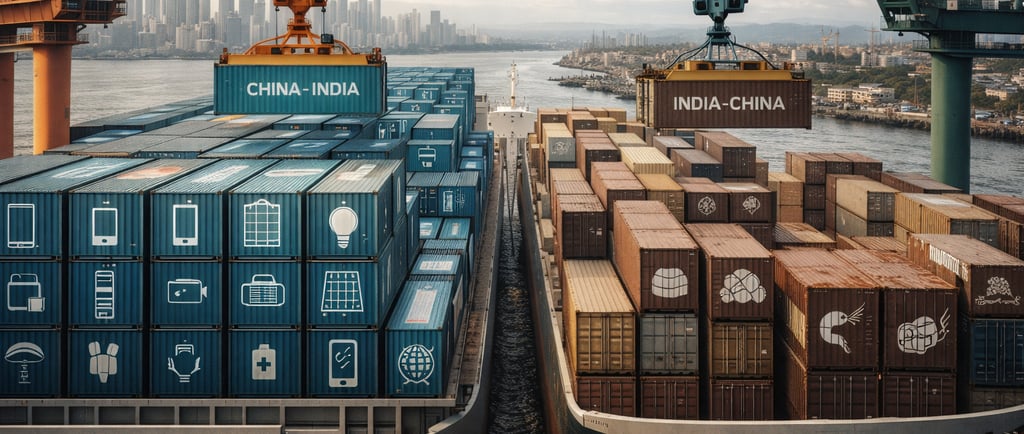
India’s trade deficit with China hit a record $99.2 billion in FY 2024-25. Currently, it stands at $54.4 billion for the first half of the current financial year (April-September 2025-26), up from $49.6 billion in the same period the previous year. The deficit for the full calendar year 2025 is projected to hit a record $106 billion.
Think about that number. Almost a hundred billion dollars—more than our IT services earnings—leaves the country each year to pay for electronics, batteries, solar cells, telecom equipment, and thousands of parts for products we use but cannot produce ourselves.
China imports $14.3 billion in goods from India: iron ore, cotton, shrimp, and castor oil. We send raw materials, and they return finished products. This isn’t how two equal economies trade. It’s more like a colonial relationship, just without the gunboats.
How did we get here?
The Numbers That Shame
The manufacturing gap between India and China isn’t just about size. It’s a completely different situation.
China’s manufacturing output in 2024 was $4.7 trillion, roughly 28-30% of global manufacturing. The country has been the world’s largest manufacturer for 15 consecutive years. Manufacturing contributes about 25% to China’s GDP and accounts for 60% of its exports.
India’s manufacturing output is approximately $500 billion, about 3% of global manufacturing. We are the fifth-largest manufacturer in the world, which sounds respectable until you realise we are home to 18% of humanity but produce barely a thirtieth of what the world makes. Manufacturing contributes about 17% to our GDP, well short of the 25% target the government set for 2025 under Make in India.
The gap isn’t closing; it’s getting bigger.
$99 Billion Exposed: The Dependency Map
The trade deficit isn’t just a number. It shows where we are most vulnerable.
We import 68-70% of our Active Pharmaceutical Ingredients from China. For specific antibiotics (penicillin, streptomycin, and ibuprofen), the dependency exceeds 95%. A supply disruption during a pandemic would not be an inconvenience. It would be a public health catastrophe.
We import 75-85% of our lithium-ion batteries from China. Every electric vehicle, every energy storage system, every smartphone battery traces back to Chinese manufacturing. Our EV ambitions are hostage to their supply chains.
We import 88% of our integrated circuits from China. The chips that run our phones, our cars, our defence systems, we cannot make them. The India Semiconductor Mission has approved projects worth $18-19 billion, but the first wafers will not roll off the line at Tata’s Gujarat fab until late 2026.
We import 56-75% of our solar cells and modules from China, down from 90% in 2022, which counts as progress. But our renewable energy targets depend on hardware we do not produce.
This isn’t real trade. It’s a dependency that looks like commerce.
The Shenzhen Miracle: How a Fishing Village Became a $550 Billion Economy
In 1980, Shenzhen was a fishing village with a population of 330,000. Its GDP was 0.2% of Hong Kong’s.
In 2026, Shenzhen’s GDP is expected to exceed RMB 4 trillion ($572+ billion). Its population is 17.79 million. It is home to Huawei, Tencent, BYD, and DJI. Its R&D spending exceeds 6.4% of GDP, higher than Israel, South Korea, or any major economy. It filed more international patents than any city in the world. In November this year, Shenzhen will host the 33rd APEC Economic Leaders’ Meeting, highlighting its role as a global innovation hub.
How did this come about?
The Special Economic Zone model that China deployed was not merely about tax breaks. It was about creating an entire ecosystem: infrastructure, logistics, labour mobility, and regulatory autonomy that functioned at an entirely different level from the rest of the economy. Shenzhen’s SEZ was 330 square kilometres from inception. It had the authority to create its own legislation. It was a controlled experiment in capitalism, with the central government watching carefully but not micromanaging.
As of today, China’s SEZs contributed 25% to national GDP, attracted 46% of foreign direct investment, and generated 60% of exports. They created an estimated 30 million jobs. In 2025 alone, China created 12.1 million new urban jobs, meeting its annual target a month ahead of schedule, with many of these roles located in or supported by the infrastructure of national-level SEZs.
India’s SEZ Graveyard: 424 Approved, 279 Operational, 92% Below Target
India launched its Special Economic Zones Act in 2005. Twenty years later, the results are disappointing.
The 2025 Comptroller and Auditor General report documented the scale of underperformance: their observations indicate that while 424 SEZs have formal approval, only 279 are operational, and the rest remain non-operational. Data suggests only 38.78% of notified SEZs have historically transitioned to full operational status.
Between FY21 and FY25, 466 SEZ units were shut down across seven central government-run zones, representing nearly 10% of total units. The total employment reached around 3.19 million, compared to China’s 30 million.
The structural problems were baked in from the start. Seventy per cent of Indian SEZs are under one square kilometre. Shenzhen alone spans 32,700 hectares. India’s zones were private developer-led; China’s were government-developed on state land with massive public investment. India’s SEZs became real estate plays for new-age corporate landlords; China’s SEZs became manufacturing heaven.
The key difference is that China’s SEZs were built to drive export-focused manufacturing with strong government support. India’s SEZs were mostly tax-saving schemes with scattered implementation. China made a strategic choice; India tried a policy experiment that never really took off.
135 Million Jobs No One Talks About: China’s TVE Secret
There’s a part of China’s industrial story that India never experienced.
Between 1978 and 1996, Township and Village Enterprises grew from 28 million to 135 million workers, absorbing half of China’s rural surplus labour. By the mid-1990s, TVEs produced 30% of national industrial output, surpassing state-owned enterprises. They pioneered labour mobility and contract systems. They created the industrial clusters that still define coastal China.
India didn’t have a similar system. Nearly 46% of our workforce stayed in agriculture or moved to informal city jobs without joining the industry. MGNREGA (now VB G RAM G) provided rural jobs, but mostly in temporary work, not manufacturing. We focused on protecting agriculture instead of helping workers move into industry.
The result is clear: China transformed its economy in one generation. India hasn’t made that shift yet.
Made in China 2025: The Masterplan India Never Wrote
In May 2015, China published Made in China 2025, a three-step strategy to become a strong manufacturing nation by 2025, a rival by 2035, and a superpower by 2049 (the PRC’s centenary). They decided to focus on ten strategic sectors: advanced information technology, robotics, aerospace, new energy vehicles, agricultural machinery, new materials, biopharma, high-end rail, maritime equipment, and power equipment.
This wasn’t just a subsidy program. It was a clear plan for technological dominance, supported by $300 billion from the government initially and another $1.4 trillion after COVID.
By the end of 2025, 86% of the plan’s 260+ goals had been achieved. China now leads globally in high-speed rail (65% world market share), electric vehicles (62% global share), solar panels (80%+ share), wind turbines (60%), drones (70-80%), industrial robots (41%), and lithium batteries (38% global share through CATL alone).
The gaps, advanced robotics, cutting-edge semiconductors, and aerospace are precisely where Western sanctions have been concentrated. Even there, China has found a way. Look at aviation, where the homegrown C919 narrowbody jet has entered commercial service on busy domestic routes, recording over 4 million passenger trips by early 2026. While cutting-edge chips (under 7nm) remain a “vulnerability” due to Western export controls, they have rapidly expanded capacity for foundational (mature-node) chips, with this segment projected to reach self-sufficiency by 2030. China accounts for 41% of the world’s installed industrial robots as of 2025, though it still relies on foreign providers for certain high-end components, a reliance it is working to reduce over the next five years.
India doesn’t have a similar plan. Instead, we have different incentives in each state, separate PLI schemes for each sector, and every program has its own timeline, ministry, agency, and way to measure success. It’s more like an industrial policy on PowerPoint than a real plan. As I always say, the PowerPoint is for those who neither have the power nor the point.
China’s approach was to pick key technologies, invest heavily in local companies, protect its market until they were competitive, and then export. India’s approach has been to announce programs, hope private companies invest, and measure success by how much money is given out rather than by real capability.
Labour Laws: The Reform That Took 75 Years
For decades, India’s labour laws were Exhibit A in the case against Indian manufacturing. Twenty-nine central laws, dozens of state variations, requirements that made hiring easy and firing nearly impossible, threshold rules that penalised firms for growing past 100 workers, and the dreaded and corrupt “inspector raj” that made compliance a matter of relationships and access rather than rules.
The economic argument was simple: if you cannot adjust your workforce when demand changes, you will not hire in the first place. You will automate prematurely. You will stay small. You will remain informal. You will not export.
On 21 November 2025, India finally implemented all four Labour Codes, consolidating 29 laws into a unified framework covering wages, social security, industrial relations, and occupational safety. The codes raise the threshold for government approval before layoffs from 100 to 300 workers. They create a single registration system. They bring gig workers and platform workers under social security for the first time.
This is a big step, but it’s also 35 years overdue.
But implementation remains India’s eternal question. Labour is a concurrent subject. As I write this, only two states, Gujarat and Arunachal Pradesh, have finalised rules under all four codes. The other states and eight Union Territories must each issue their own implementing rules. A national law has become 36 different regulatory regimes.
The outcome is no surprise: 70% of manufacturing jobs are still informal. Companies keep their staff numbers low to avoid extra rules. Formal jobs are rare, and informal workers have little protection.
China’s labour flexibility was always overstated and its exploitation understated. The hukou system (the internal passport that tied workers to their birthplace for social benefits) effectively created a mobile but precarious workforce that could be hired and fired at will. It was exploitation that enabled industrialisation. India’s labour laws, by contrast, protected those with formal jobs while leaving 90% of the workforce in the informal sector without any protection at all.
The four Labour Codes help with some of these issues. But the real question is whether they will actually be put into practice.
Make in India: An Honest Ledger
Prime Minister Modi launched Make in India in September 2014 with characteristic ambition: raise manufacturing’s share of GDP to 25%, create 100 million new jobs, and turn India into a global manufacturing hub.
Ten years later, manufacturing’s share of GDP is still about 17%. The 100 million new jobs haven’t appeared. Government and private estimates of manufacturing jobs differ significantly: the government says there are about 74 million, while private data puts it at only 27 to 28 million. Still, it would be wrong to call Make in India a failure. The reality is more complex.
The Production-Linked Incentive schemes, launched across 14 sectors with an outlay of ₹1.97 lakh crore, have delivered tangible results. By March 2025, PLI schemes had attracted ₹1.76 lakh crore ($21 billion) in investment, generated ₹16.5 lakh crore in production and sales, and created over 12 lakh direct and indirect jobs.
Mobile phones tell the most dramatic story. Production surged from ₹18,900 crore in FY 2014-15 to ₹5.45 lakh crore in FY 2024-25, a 28-fold increase. Manufacturing units grew from 2 to over 200. Mobile phone exports, which barely existed a decade ago, crossed ₹1.6-2 lakh crore ($20+ billion). We now account for 99% of domestic smartphone demand, up from 25% in 2014.
The iPhone ecosystem is particularly striking. India assembled iPhones worth $22 billion in FY 2024-25, a 60% year-over-year increase. Foxconn committed $1.5 billion in fresh investment in May 2025, with plans to double iPhone production by year-end. Apple now aims to have all US-bound iPhones manufactured in India by 2026. Tata Electronics, which acquired Wistron’s operations, employs nearly 50,000 workers at its facilities.
Pharmaceuticals achieved strategic import substitution. India was a net importer of bulk drugs (APIs) with a ₹1,930 crore deficit in FY 2021-22. By FY 2024-25, we had become a net exporter, with a surplus of ₹2,280 crore. Domestic value addition reached 83.7%, a critical win in a sector where Chinese dominance had become a national security concern.
Telecom equipment has achieved 60% import substitution. Automotive PLI attracted ₹67,690 crore in investment against a ₹26,000 crore target. Solar panel manufacturing capacity expanded to 68 GW for modules and 25 GW for cells by March 2025, though we still import 75% of cells from China.
The trend is clear: when the government picked certain sectors, gave focused incentives, brought in key investors, and stayed committed, there were results. The problem is with scale and getting funds out—only 16% of the ₹1.97 lakh crore PLI budget has been used. India can’t become a manufacturing leader by using PLI schemes one sector at a time. It’s like using a scalpel when we really need a much bigger tool.
The Vietnam Problem
Every discussion of India’s manufacturing potential must now contend with Vietnam.
In 2025, Vietnam attracted record FDI disbursements of $27.62 billion, a 9% increase over 2024 and the highest level recorded in five years. Its exports exceeded $475 billion. Samsung alone accounts for nearly 14% of Vietnamese exports, not just electronics, but total national exports. Vietnam is now the second-largest smartphone exporter in the world after China, with over 13% market share.
Vietnam has some clear advantages over India, even if it’s uncomfortable to admit: lower wages (about $300 a month, compared to India’s $150-400 depending on the region), a simpler regulatory system (one country, one policy, instead of 28 states with different rules), closer access to Chinese supply chains, better ports, and free trade deals with almost everyone (EU, UK, CPTPP, RCEP, ASEAN).
Vietnam is capturing the China+1 opportunity that India was supposed to seize. A NITI Aayog report in December 2024 acknowledged India’s “limited success so far” in benefiting from supply chain diversification. For the first time in a decade, Southeast Asia’s six largest economies attracted more FDI than China.
But Vietnam also has weaknesses that India can use to its advantage. Its population is 100 million, just one-fourteenth the size of India’s. It can’t handle the same scale of manufacturing as our 1.4 billion people. Being close to China is also a risk, since supply chain managers worry about Vietnam’s political and economic ties to Beijing.
India’s strengths are its size and independence. We aren’t under the control of any other country. Our huge domestic market can keep manufacturing going even if exports drop. And our democracy, despite its messiness, gives us political stability that authoritarian systems can’t promise over the long term.
The real question is whether we can turn these strengths into real manufacturing results before it’s too late.
What Actually Needs to Happen
As someone who has advised Chief Ministers and bureaucrats, I’ve seen many industrial policy announcements come and go, each one promising significant changes but often ending in disappointment. The cycle is familiar: a big launch, Bollywood-style star-studded investment events, global roadshows, excitement from ministers, then bureaucracy, failed implementation, blame, and finally a new scheme.
What would actually work?
First, land. This is the biggest obstacle for Indian manufacturing. The 2013 land acquisition law, meant to protect people, made it almost impossible to get large areas for industry. States like Gujarat (with land pooling), Tamil Nadu (with the SIPCOT model), and Odisha (with industrial corridors) have found ways around this and attracted more investment. The central government needs to either change the law or let states use other methods. China took land by force, but we can’t and shouldn’t do that. Instead, we can set up land banks, simplify the process, and settle disputes more quickly.
Second, infrastructure at industrial sites. India often builds highways for general traffic, not for factories. If an expressway skips an industrial area, it helps politics, not productivity. China builds infrastructure first, then brings in industry. We do the opposite—bring in industry, then promise infrastructure. The order is essential. The PM Gati Shakti National Master Plan, which uses GIS planning across 16 ministries, is a good step. But as always, success depends on how well it’s carried out.
Third, logistics. India’s logistics costs are now 7.97% of GDP, close to the 7-8% seen in developed countries. That’s progress. But most freight still moves by road (over 60%), while only 6% goes by water, compared to 47% in China. Every container that travels by road instead of rail or water costs us money. Port wait times are better now, but still longer than in Singapore, Shanghai, or Colombo.
Fourth, power. Electricity for industry in India is among the most expensive in Asia, about 30-40% higher than in Vietnam and 50% higher than in Indonesia. Industrial users end up paying more to subsidise farmers and households, which is politically popular but bad for business. No PLI scheme can make up for these high costs. States like Gujarat and Tamil Nadu, which have made power cheaper for industry, have attracted more factories. Others keep subsidising farmers and lose out on manufacturing.
Fifth, single-window clearance means that. Every state says it offers single-window approval, but investors know this isn’t true. A real single-window would require a single agency with the power to overrule others, which is nearly impossible in India’s federal system without strong political will. At the very least, we need time limits: if the government doesn’t respond in 30 days, approval should be automatic. Silence should mean yes, not endless waiting.
The Democratic Difference
China’s manufacturing success was built on foundations we shouldn’t copy. The hukou system exploited workers. Labour rights were harshly suppressed. The environment suffered severely, and the air in industrial cities was unsafe for years. Political repression kept workers quiet, but at a substantial human cost.
But we can’t use these reasons to excuse our own failures. Countries like South Korea, Taiwan, Germany, and Japan all built strong manufacturing sectors within democracies. They succeeded by having good institutions, strong education, cost-cutting infrastructure, and governments that actually carried out their policies.
India’s democratic limits are real, but they aren’t impossible to overcome. We need to consult and build agreement, not just give orders. This slows the change, but it doesn’t make it impossible.
It took 75 years to pass the four Labour Codes. Land reform might take another generation. But there are things we can do now: make electricity tariffs fair, improve port processes, actually deliver on single-window promises, speed up infrastructure at industrial sites, and make sure PLI payments match approvals.
The gap with China is the result of decades of choices. We can’t close it overnight, but we can keep it from getting bigger. We can grow manufacturing one sector at a time, as PLI has shown. We can bring in supply chains that are moving out of China, as Apple has done. And we can use our large domestic market to boost exports.
The other option is to remain dependent, importing what we use and exporting only raw materials, and celebrating every Diwali with lights made in Shenzhen.
Previous: Part 3 — The Learning State Next: Part 5 — The Path of the Elephant
Sources and Credits: This article draws on data from the Ministry of Commerce and Industry, Government of India; Department for Promotion of Industry and Internal Trade (DPIIT); Press Information Bureau releases on PLI schemes and Labour Codes; Comptroller and Auditor General SEZ Performance Audit 2014; China Briefing manufacturing trackers; India Briefing manufacturing and PLI reports; Embassy of India, Beijing bilateral trade data; UNCTAD World Investment Report 2025; World Bank logistics performance indicators; McKinsey Global Institute China+1 analysis; Reuters and Bloomberg reporting on Apple manufacturing; Shenzhen Government Online statistical yearbook; and Vietnamese Ministry of Planning and Investment FDI reports.