
The Dragon Stumbled. Now the Elephant Must Run.
This is the last part of a five-part series on what India can learn from China’s transformation. Part 1 looked at China’s governance system. Part 2 covered infrastructure like roads, railways, and ports. Part 3 focused on education, research, and human capital. Part 4 examined manufacturing, industrial policy, and our $99 billion deficit. Today, we look ahead: what India should do, what to avoid, and why our slower progress may last longer than China’s rapid rise.
ECONOMYLEADERSHIPCHINAMADE IN CHINAPOLITICSDEMOCRACYINDIAMAKE IN INDIAGOVERNANCE
Part 5 of 5: Learning from China without Losing Our Soul
In 1980, China and India had roughly comparable per capita incomes. Deng Xiaoping had just launched his reforms. The License Raj still shackled India. Both nations were poor, agrarian, and searching for a path to prosperity.
Forty-five years later, China’s economy is six times bigger than India’s. Its per capita income is five times higher. China manufactures more than any country ever has. The difference between us comes from decades of decisions, not just a few years.
And yet.
China’s fertility rate has dropped to 1.01, the lowest in the world. Its population is shrinking. Debt has reached 336% of GDP by mid-2025. Many talented people are leaving the country. Political interference has hurt the tech sector. Foreign investment is now leaving China, with $168 billion flowing out in 2024. This trend continued in 2025, as actual foreign direct investment fell by 20.4% in the first two months, while Chinese investment abroad rose by 15.7%.
India, on the other hand, has the world’s youngest major workforce. Our democracy, despite its flaws, offers stability that authoritarian systems cannot promise over time. Our institutions are not perfect, but they can correct themselves. Many Indian entrepreneurs do not worry about sudden political crackdowns.
The real question isn’t if India has an opportunity, but whether we will take it before it’s gone.
What the Dragon Taught the Elephant
Before we look ahead, I want to share what I’ve learned so far.
On institutions: China built a governance machinery that plans in decades and executes in months. The five-year plan is not a slogan but a binding contract between levels of government. Cadre evaluation systems create accountability. India’s bureaucracy, by contrast, plans in electoral cycles and executes in court adjournments. We have the architecture of a developmental state without its animating spirit.
On infrastructure: China built rapidly, while we got stuck in paperwork. They built 50,400 kilometres of high-speed rail, while we have none in operation. They created the world’s largest expressway network in just twenty years, but our highways still go through city centres. The problem isn’t resources; India’s infrastructure budget has grown significantly, but execution is slow, and coordination is poor.
On education and research: China invested in minds while we printed degrees. Their R&D spending reached 2.4% of GDP; ours languishes at 0.70% of GDP. Their universities climb global rankings while ours slide. Their patent filings dwarf ours. We produce more engineers than any country except China, but only half are employable.
On manufacturing: They built factories while we built regulations. China captures 28-30% of global manufacturing; we manage 3%. Our trade deficit with China alone, $99 billion, exceeds our total IT services exports. We remain dependent on Chinese imports for 70% of our pharmaceuticals’ active ingredients, 85% of our lithium batteries, 88% of our integrated circuits.
The pattern is clear: China set priorities, gathered resources, built strong institutions, and followed through. India, by contrast, announced programs, spread tasks across ministries, set up oversight, and then saw plans fail because of poor coordination.
The Window Won’t Wait
China’s structural crises are not cyclical adjustments. They are existential challenges that create a 10-15-year window for India, if we act decisively.
The demographic collapse is unprecedented. China’s fertility rate of 1.01 is the world’s lowest, well below the 2.1 replacement rate. The working-age population has been shrinking since 2012. UN projections show a decline of over 200 million people between 2024 and 2054. India’s working-age population surpassed China’s: 2,490 million versus 984 million in the 15-64 cohort. China’s median age will rise from 40 to over 50 by mid-century; India’s remains at 28.
The debt overhang has reached crisis proportions. Total debt hit 336% of GDP by mid-2025. Local Government Financing Vehicle debt totals around $18.9 trillion, and most cannot service the interest without subsidies. 66% of new debt being issued by local governments is used to pay existing debt rather than for new, productive investments. The property sector, which once contributed 30% of GDP, has collapsed. Evergrande’s more than $300 billion default was merely the most visible casualty.
Xi Jinping’s centralisation has driven talent and capital flight. Some 15,200 high-net-worth individuals emigrated in 2024; another 7,800 emigrated in 2025, and, according to estimates, the trend will continue in 2026 as well. The tech crackdown destroyed over $1 trillion in market value. Jack Ma was effectively exiled. Ant Group’s $37 billion IPO was blocked. Big tech firms remain mired in single-digit growth. The message to entrepreneurs is clear: success makes you a target.
Foreign investment has reversed. China experienced a net FDI outflow of $168 billion in 2024, the largest capital flight in three decades. While inbound investment declined, China’s total ODI rose 6.2% in the first 10 months of 2025, reaching $144.34 billion. The “China Plus One” strategy is no longer theoretical. Apple now manufactures iPhones worth $34 billion annually in India. HP shifted 90% of North American products outside China by the end of 2025.
This is India’s moment. But moments don’t last forever.
The $30 Trillion Gamble
NITI Aayog’s Viksit Bharat vision sets extraordinary targets: a $30 trillion economy by 2047, a per capita income of $18,000, and manufacturing at 25% of GDP. Finance Minister Sitharaman called it “conservative.”
The numbers are tough. To reach $30 trillion from today’s $4.2 trillion, India would need to grow its economy nine times over. That means 7.8-9% real growth every year for twenty years. India has only managed over 8.5% growth for six or seven years since the 1980s. Keeping that up for two decades would be a first in our history.
The World Bank’s assessment is sobering: “What got you here won’t get you there.”
Yet dismissing the target as fantasy would be equally wrong. India’s current trajectory, if sustained at 6-7% growth, would still produce a $15-18 trillion economy by 2047, making us the world’s third-largest. The question is whether we aim for developed nation status or settle for upper-middle-income mediocrity.
To be honest, $30 trillion is a big goal, but it’s not out of reach. It will take reforms in India’s long-standing struggles: land, labour, power, and governance. We need to follow through on what we announce and keep up the effort, no matter who is in power.
It means India will have to change in ways we haven’t before.
Where We Stand
India’s starting point is better than pessimists think, but not as strong as optimists claim.
The strengths are real. GDP crossed $4.18 trillion, making India the world’s fourth-largest economy. Total exports reached $825 billion in FY25, with services alone at $387 billion. For the current fiscal year (FY26), total exports are projected to reach approximately $850 billion, with services exports inching past $400 billion. UPI processed 228 billion transactions in 2025, more than any payment system in history. Foreign exchange reserves hover near $688.19 billion. The startup ecosystem ranks third globally with over 118 unicorns.
Infrastructure has accelerated. National highways expanded to 146,000 kilometres. Airport count doubled to 160. Power capacity reached 505 GW with non-fossil sources crossing 50% in June 2025, five years ahead of our Paris commitments. Railway electrification reached 99.2%.
The weaknesses persist. Per capita income of $2,850 keeps us classified as lower-middle-income, ranking 136th globally. The Human Development Index rank of 134th places us just below the “high human development” threshold. Manufacturing remains stuck at 15-17% of GDP despite a decade of Make in India. R&D intensity at 0.7% trails China (2.4%), Korea (4.5%), and even the global average. Agricultural productivity employs 46% of the workforce but contributes only 17% of GDP.
Most worrying, 82% of jobs are still in the informal sector. We still haven’t created enough formal jobs that offer security, skill growth, and career paths.
The Bets That Are Paying Off
Some bets are already paying off. Others require acceleration.
Electronics manufacturing has been the most apparent success. Production grew from ₹1.9 lakh crore in FY15 to ₹12.50 lakh crore (projected) in FY26, a sixfold increase. Mobile phone exports have surpassed the $23 billion mark annually and are projected to reach $30 billion by the end of FY26. Apple’s India-made iPhones have exceeded $50 billion in cumulative exports under the PLI scheme. We now account for 99% of domestic smartphone demand, up from 25% a decade ago.
Semiconductors represent the strategic frontier. Ten projects totalling ₹1.6 lakh crore have been approved, including Tata’s $11 billion fab in Dholera targeting production by late 2026. India is wisely focusing on legacy nodes (28nm-110nm), which constitute the bulk of global demand, rather than chasing cutting-edge fabrication, where Taiwan and Korea have insurmountable leads.
Pharmaceuticals achieved critical import substitution. India supplies 20% of global generic drugs by volume and 40% of the US market. The Production Linked Incentive (PLI) scheme for bulk drugs has successfully enabled domestic production of 40 critical Active Pharmaceutical Ingredients (APIs) as of late 2025 data, slightly up from 38, further reducing dependence on Chinese imports. The overall dependency has decreased from around 70% to approximately 55% in key areas.
Biosimilars remain a critical growth frontier. India has approved over 140 biosimilars domestically, maintaining its position as the global leader in approvals. With approximately $64 billion in biologic patents expiring between 2025 and 2029, Indian companies are strategically positioned to capture significant market share. The Indian pharmaceutical market is projected to reach approximately $65 billion in value by 2026, while pharma exports are projected to hit $29 billion for FY26.
Renewable energy exceeded expectations. Total non-fossil fuel power capacity (including renewables, large hydro, and nuclear) reached 262.74 GW as of late 2025. This now accounts for 51.55% of India’s total installed electricity capacity (509.64 GW), confirming that the nation officially met its Paris Agreement target five years ahead of the 2030 schedule. Solar capacity exceeds 132.85 GW, and wind energy installed capacity currently stands at approximately 53.99 GW.
The Green Hydrogen Mission targets 5 million tonnes annually by 2030. As of late 2025, 19 companies have already been allocated cumulative production capacity for 862,000 tonnes per annum, and the first major port-based pilot projects have been commissioned.
Defence production hit a record ₹1.5 lakh crore in FY25, with exports reaching ₹24,300 crore, a 34-fold increase in eleven years. For the current fiscal year (FY26), the government projects exports will reach ₹35,000 crore (approximately $4.2 billion). BrahMos missiles are now being sold to the Philippines and Indonesia. We are finally exporting weapons rather than only importing them.
Global Capability Centres have become a quiet powerhouse. Revenue reached $70 billion, employing more than 2 million professionals across 1,850 centres. India hosts 45% of global GCC talent. The industry association (Nasscom) projects the GCC market in India to reach $110 billion in revenue by 2030, employing over 2.7 million people. These are not call centres but sophisticated engineering, R&D, and AI operations, the kind of high-value services that can engage our educated workforce.
The same pattern shows up in successful sectors: the government set clear priorities, offered the right incentives, made key investments, and kept policies stable. But in areas like textiles, food processing, and tourism, we hesitated and lost ground to competitors.
The Clock Is Ticking
India’s demographic window (the period when the working-age population exceeds the number of dependents) runs from 2005-06 to 2055-56. This is the longest window any country has enjoyed, at fifty years. But it is not infinite.
The working-age population will peak around 2041 at approximately 1.05 billion. Currently, over half of our 1.4 billion people are under 25. Our median age of 28 is two decades younger than China’s.
This should give us a huge advantage. So far, it hasn’t.
India needs 10-12 million jobs annually to absorb youth entering the workforce. Recent data shows improvement: EPFO enrollments reached 14 million in FY25, the highest ever and double FY19 levels. But the quality of employment matters as much as quantity. Most new jobs are self-employment or informal work without security or progression.
Youth unemployment stands at 16%. More troublingly, 24-26% of youth are not in employment, education, or training. The “NEET” population represents wasted potential and social risk. Graduate unemployment has doubled since 2000, from 35% to 65%. The education-employment mismatch, in which only half of engineering graduates are job-ready, represents a systemic failure.
Female labour force participation rose to 43.7% in 2024-25, up from 23% in 2017-18. But much of this is rural, unpaid, self-employment rather than formal wage labour. Women constitute half our population but a fraction of our productive workforce. Reaching the Viksit Bharat target of 70% requires universal childcare, safe transportation, remote work frameworks, and industry-focused training.
The four states, Uttar Pradesh, Bihar, Madhya Pradesh, and Rajasthan, where the demographic dividend has yet to fully open account for over 40% of India’s population. Bihar’s per capita income is one-third of Punjab’s. If these states fail to industrialise, the national dividend becomes a demographic disaster.
This window of opportunity won’t last. By 2040, the number of dependents will start to rise. By 2055, the window will close. What we do in the next ten years will decide if we make the most of this chance or waste it.
Tigers, Not Dragons: Korea, Taiwan, Germany
The prevailing narrative that only authoritarian systems can drive rapid development is contradicted by history.
South Korea transformed from a per capita income of $94 in 1961 to over $37,000 today within a democratic framework. Park Chung-hee’s developmental state-directed industrial policy promoted chaebols like Samsung and Hyundai and invested heavily in education. The 1987 democratic uprising, driven by a middle class created by economic success, forced political opening. Growth slowed from 9% to 6% but continued, with the economy becoming more sophisticated as institutions strengthened.
Taiwan followed an SME-led model. The Industrial Technology Research Institute identified industrial niches; government-backed spinoffs created private champions. TSMC received 48% of its startup capital from the National Development Fund in 1987. Today, it holds over 50% of the global advanced chip manufacturing market. Democratic consolidation accompanied, not hindered, high-tech development.
Germany’s social market economy balanced free enterprise with social welfare. The Mittelstand (family-owned SMEs comprising 99% of German companies) employ 70% of the workforce. The dual vocational system produces graduates with 90% employment rates. Youth unemployment runs at 6-7% compared to the EU average of over 20%.
Japan’s MITI model demonstrates that active industrial policy is compatible with democracy. Sequential sector targeting: textiles in the 1950s, steel and shipbuilding in the 1960s, semiconductors in the 1970s, was followed by liberalisation after building competitive capabilities.
Common success factors include: strategic government involvement without micromanaging; massive investment in education and skill development; export orientation that imposed quality discipline; pragmatic flexibility in adapting to circumstances; and strong institutions with merit-based bureaucracies.
Importantly, real change took 20 to 40 years of steady policy in other countries. India needs to accept this timeline. We won’t be a developed nation by 2030, but if we start and keep up the right reforms now, we can get there by 2047.
What the Elephant Must Never Become
Learning from China does not mean becoming China. Some elements of their development model are neither replicable nor desirable.
The hukou system was institutionalised exploitation. China’s internal passport tied 290 million rural migrants to their birthplace for access to social benefits such as healthcare, education, and pensions. This created a mobile but precarious workforce that could be hired and fired at will, suppressing wages and domestic consumption. India’s democratic framework and portable social benefits are competitive advantages, not constraints.
Environmental destruction accompanied growth. While Beijing reduced the number of heavy pollution days from 58 in 2013 to one by 2025, the improvement came from relocating factories to surrounding provinces, shifting rather than eliminating the damage. Soil contamination affects agricultural land across multiple regions. Rivers remain poisoned. India must integrate environmental protection into its development strategy, not sacrifice breathable air for GDP points.
Debt-fuelled growth created structural vulnerabilities. China’s total debt rose from 95% of GDP in 1995 to 336% today. Each stimulus required more debt for less growth. Local government financing vehicles that receive $139 billion in subsidies while generating $76 billion in profits exemplify capital misallocation at scale. India’s fiscal discipline, while constraining, prevents similar traps.
The tech crackdown destroyed entrepreneurial dynamism. Blocking Ant Group’s IPO, exiling Jack Ma, and fining Alibaba $2.8 billion chilled innovation and drove talent flight. Entrepreneurs who fear political retaliation do not take risks. India’s regulatory predictability and democratic accountability attract long-term investment that authoritarian systems cannot guarantee.
Suppression of dissent is not efficiency. The social credit system, surveillance state, and political repression that keep Chinese society docile exact costs that compound over decades. Trust in institutions, in the future, in each other, is the foundation of sustainable development. China’s collapsing birth rate reflects what one analyst called “the conviction that parenthood no longer makes sense in a future that feels uncertain.”
India’s democratic way is slower. It needs discussion, not orders. It requires agreement, not commands. This makes reform harder, but not impossible. And it leads to results that last.
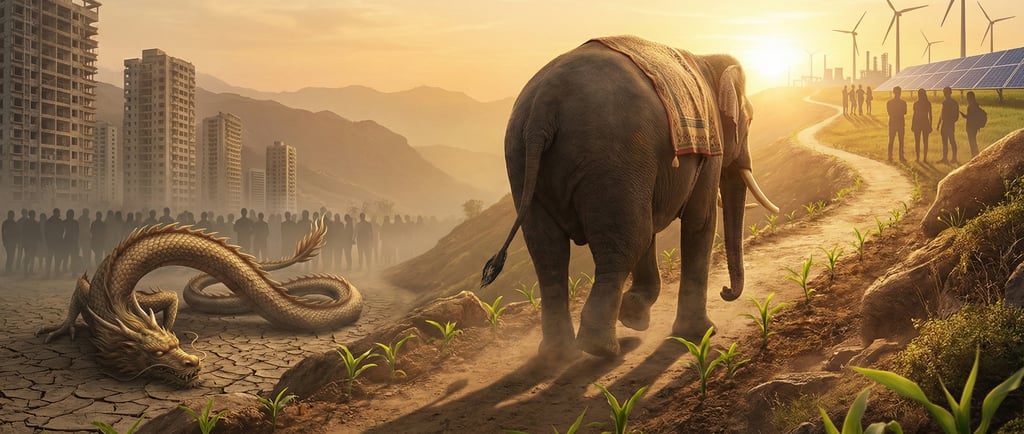
The elephant moves slowly and carefully, but it does not trip.
The Roadmap
After decades of working with governments, I’ve learned to distinguish between what’s announced and what actually gets done, between plans and real results. The real gap between India’s potential and reality isn’t about resources or ideas—it’s about getting things done.
On land: Everything in Indian development crashes against this rock. The 2013 land acquisition law, well-intentioned as a social protection measure, made large-scale industrial land assembly nearly impossible. States that found workarounds (Gujarat’s land pooling, Tamil Nadu’s SIPCOT model, Odisha’s industrial corridors) attracted disproportionate investment. We need national land banks, streamlined procedures, and dispute resolution that does not take decades.
On labour: The four Labour Codes implemented in November 2025 consolidated 29 central laws into a unified framework. The retrenchment threshold rose from 100 to 300 workers. Gig workers gained legal recognition. This is historic, but 35 years late. Implementation across state and union territory jurisdictions will determine whether the reform is real or rhetorical.
On power: Indian industrial electricity costs are 30-40% higher than in Vietnam and 50% higher than in Indonesia. Cross-subsidies from industrial to agricultural users are politically untouchable but economically devastating. No PLI incentive can compensate for structural cost disadvantages. States that rationalised tariffs attracted manufacturing. Others continue subsidising farmers while driving factories away.
On skills: We have trained 60 million youth under the Skill India program. Only 55% are employable. The gap between training and employment persists because curricula are designed by academics rather than industry, because apprenticeship systems remain underdeveloped, and because the signalling value of formal degrees exceeds the practical value of vocational certification. Germany produces 1.3 million apprentices annually, in a population one-sixteenth the size of India’s. We make 10 lakh.
On R&D: Spending remains stuck at 0.7% of GDP despite absolute amounts doubling. The private sector contributes only 36%, compared with 70%+ in developed economies. Reaching the 2% target requires restoring the 200% super-deduction for research expenses, expanding patent-box regimes, and creating R&D hubs with SEZ-like benefits.
On trade: We signed FTAs with the UK, EFTA, New Zealand, and Oman in 2025, more progress in one year than the previous decade. But FTA utilisation remains a challenge: only 25% of Indian exporters use available preferences, compared with 70-80% in developed countries. The agreements matter less than the capacity to exploit them.
On states: India will not develop uniformly. Gujarat, Tamil Nadu, Karnataka, and Maharashtra are already upper-middle-income by some measures. Bihar and UP remain closer to low-income countries. Competitive federalism has produced results. The question is whether lagging states can learn from leaders, or whether regional divergence becomes a permanent fracture.
Three Indias in 2047
In the best case, India reaches $10 trillion by 2030 and $30 trillion by 2047. Manufacturing rises to 25% of GDP. Female labour force participation reaches 50%+. Investment rates climb to 40% of GDP. Education reforms produce industry-ready workforces. Climate adaptation minimises damage. We become a developed nation at our independence centenary, a transformation unprecedented in scale and achieved within a democratic framework.
In the base case, India grows at 6-7% annually, reaching $8 trillion by 2030 and $18 trillion by 2047. Per capita income reaches $10,000- $12,000, upper-middle-income but not developed. Manufacturing stays at 18-20% of GDP. We consolidate as the world’s third-largest economy but fall short of ‘Viksit Bharat’ ambitions. The demographic dividend is partially captured, partially wasted.
In the worst case, youth unemployment persists at 20%+. Manufacturing remains at 14% of GDP. Climate shocks devastate agriculture. Global uncertainty disturbs domestic demand. Water scarcity affects 600 million Indians. Heat stress eliminates 34 million jobs. The demographic dividend becomes a demographic disaster, a billion young people without prospects, without hope, without any stake in the system.
The difference between these futures isn’t destiny. It’s up to us.
The Path Ahead
I began this series by asking what India can learn from China without losing its soul. After examining institutions, infrastructure, education, and manufacturing, the answer has become clear.
We can learn discipline without adopting authoritarianism. We can learn planning without abandoning democracy. We can learn execution without sacrificing accountability. We can learn ambition without destroying our environment, exploiting our workers, or crushing our entrepreneurs.
China sprinted. The dragon covered ground that seemed impossible. But the sprint has exhausted the runner. Demographics are destiny, and China’s demographic destiny is in decline. Debt is cumulative, and China’s debt has reached unsustainable levels. Trust is fragile, and China’s suppression of dissent has shattered the confidence that sustains long-term investment.
India moves at a walking pace. The elephant moves carefully, sometimes more slowly than we’d like. Our democracy can be inefficient. Our federal system causes coordination problems. Courts are slow, the bureaucracy can block progress, and politics can be distracting.
But the elephant doesn’t trip or wear itself out. It reaches places that sprinters, worn out along the way, never get to see.
The next twenty years will determine whether India becomes a developed nation or remains a developing one. The window created by China’s crisis, by our demographic dividend, and by the global realignment of supply chains will not stay open forever.
We have the chance. We have the resources. We have the people.
Now, we need the will to act and the wisdom to do it well.
The path of the elephant is ahead of us.
This is the end of my India-China Series. At least, for now.
Previous: Part 4 - The Industrial State Read the First Part
Sources and Credits: This article draws on data from NITI Aayog’s Viksit Bharat 2047 approach paper; IMF World Economic Outlook October 2024 and January 2025 updates; World Bank India Development Reports; UN Population Division World Population Prospects 2024; Reserve Bank of India Annual Reports; Ministry of Commerce trade statistics; Ministry of Finance Economic Survey 2024-25; PIB releases on labour codes, PLI schemes, and infrastructure; NASSCOM GCC reports; ILO World Employment and Social Outlook; McKinsey Global Institute India analyses; and academic research on democratic development models.