
They Built. We Debated. The Gap Grew.
This is the second article in a five-part series about what India can learn from China's transformation. In Part 1, we explored the systems underpinning Chinese governance, such as the cadre evaluation system, controlled experimentation, and accountability. Today, we look at the physical infrastructure: roads, railways, ports, and power grids, that helped turn a rural economy into the world's manufacturing centre.
ECONOMYLEADERSHIPCHINAINDIAGOVERNANCEINFRASTRUCTURE
Part 2 of 5: Learning from China without Losing Our Soul
In 1990, India had more highway kilometres than China.
Think about that for a moment.
Today, China has approximately 199,000 kilometres of expressways, while India has about 6,000 kilometres. China added around 8,000 kilometres of new expressways in 2025 alone. India's goal for 2025-26 is 10,000 kilometres in total, which is its lowest target in seven years.
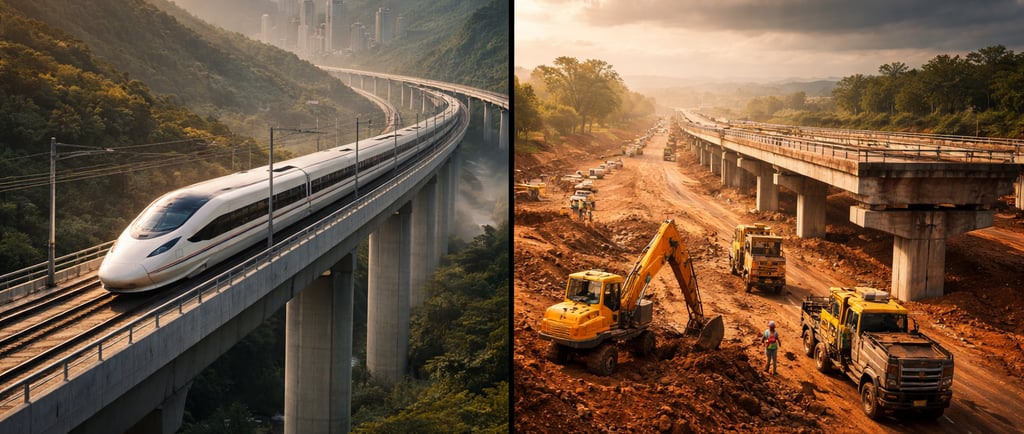
China's high-speed rail network crossed a historic milestone on 26 December 2025, surpassing 50,000 kilometres with the opening of the Xi'an-Yan'an line. It remains the longest in the world, with trains running at 350 kilometres per hour. On 29 December 2024, China unveiled the CR450 prototype, capable of test speeds of 450 kilometres per hour and an operational speed of 400 kilometres per hour, set to enter commercial service by 2026. India's first bullet train project, announced in 2017, had 331 kilometres of viaduct completed by 21 December 2025. The first 100-kilometre section between Surat and Vapi is expected to open on 15 August 2027, with the entire route not expected to be fully operational until December 2029, nearly seven years after the original completion date.
In 2024, Shanghai's port handled 51.51 million TEUs (twenty-foot equivalent units), becoming the first port to exceed 50 million TEUs. India's busiest port, JNPT in Mumbai, handled 7.05 million TEUs in calendar year 2024, a significant improvement but still a fraction of Shanghai's capacity. Shanghai alone moves more containers than all of India's major ports put together.
These numbers are more than just statistics. They reveal the true base of economic strength.
The Land Question
Every conversation about Indian infrastructure eventually comes back to land acquisition.
In China, the state owns all land. When the government decides to build a highway, railway, or industrial park, it can get the land quickly. People are compensated, and their objections are recorded, but the project still moves forward.
In India, securing land for projects is always a challenge.
The Land Acquisition Act of 2013, officially called the Right to Fair Compensation and Transparency in Land Acquisition, Rehabilitation and Resettlement Act, replaced a colonial-era law from 1894. It was designed to protect landowners from the arbitrary dispossession that had characterised Indian development for decades. The law mandates Social Impact Assessments before acquisition. It requires consent from 70% of affected landowners for public-private partnership projects and 80% for private projects. Compensation must be four times the market value in rural areas and twice the market value in urban areas.
These protections are fundamental and essential. I have seen the harm caused when governments push projects through without talking to people. Forcing people out without helping them rebuild their lives causes real suffering.
But the 2013 Act has also caused many projects to stall.
A report submitted to Parliament in December 2018 found that over 435 infrastructure projects had been delayed due to land acquisition issues and regulatory approvals. The Mumbai-Ahmedabad Bullet Train, India's flagship high-speed rail project, has faced persistent challenges in acquiring the necessary land, though over 98% of the required land in Gujarat and 71% in Maharashtra has now been acquired. In Noida alone, 37 road projects remain stalled because of unresolved land disputes, fragmented ownership, and legal challenges.
Social Impact Assessments can take six to twelve months. Negotiating consent often takes years. Anyone affected can go to court, and many do. Both good and bad projects face the same slowdowns. Honest and dishonest officials deal with the same complicated process.
China's approach comes with its own costs, like relocating people without their input, causing environmental damage without enough review, and forcing communities to leave with few choices. But India's way has costs as well. Every year a highway is delayed, businesses spend more to move goods. Every year a port is delayed, exports are lost, and jobs are not created.
The real question is not about protecting landowners, but whether that protection should block progress.
The Speed That Stuns
Indian policymakers should take this comparison seriously.
China's construction machinery can lay 10 to 15 kilometres of expressway per day. One machine reportedly completed 19 kilometres in 24 hours. Their tunnel boring machines advance at 50 metres per day, cutting project timelines by up to 18 months. In December 2025, China opened the world's longest expressway tunnel, the 22.13-kilometre Tianshan Shengli Tunnel in Xinjiang, slashing what was once a several-hour mountain drive to just 20 minutes.
India built an average of 29 kilometres of national highways per day in 2024-25, a solid number and a real improvement over the past decade, though down slightly from the peak of 34 kilometres per day in 2023-24. India's record is 37.5 kilometres in a single day, but for China, that is routine.
The difference is not just about the machines. It's about the whole system: faster approvals, land ready when needed, contractors held accountable for delays, and officials whose careers depend on finishing projects, not just starting them.
Consider the Delhi Metro. Phase 1 took about eight years from approval to completion. The Shenzhen Metro's Line 11, at 52 kilometres, was completed in about four years. Line 12, opened in 2022, took a similar time. Chinese cities now have over 10,000 kilometres of operational metro rail. India crossed the historic 1,000-kilometre mark in October 2025, reaching 1,090 kilometres across 26 cities by year-end, becoming the world's third-largest metro network. The Delhi Metro alone now carries 4.6 million passengers daily.
Or consider ports. When China decided Shenzhen would become a major container hub, it built the infrastructure to make it happen. Today, seven of the world's ten busiest container ports are in China. Shanghai, Ningbo-Zhoushan (39 million TEUs), Shenzhen (33 million TEUs), Qingdao, Guangzhou, Tianjin, and Xiamen collectively handle more container traffic than the following 20 ports combined.
India's Sagarmala programme, launched in 2015, aims to modernise ports and develop coastal infrastructure. JNPT has now crossed 10 million TEUs in capacity with the commissioning of BMCT Phase 2 in January 2025. The proposed Vadhavan Port, with a planned capacity of 23 million TEUs, represents a significant leap forward. But a substantial gap remains between plans and actual results.
What Modi Has Built
It's important to give credit where it's due.
The Modi government has made infrastructure a genuine priority, backed by unprecedented budgets. The Ministry of Road Transport and Highways saw a 570% increase in funding between 2014 and 2023-24. Investment in road infrastructure increased 6.4 times between 2013-14 and 2024-25.
The Bharatmala Pariyojana, launched in 2017, aims to develop 34,800 kilometres of highways. As of March 2025, 20,378 kilometres have been constructed, with projects awarded for 26,425 kilometres. The Delhi-Mumbai Expressway, at 1,386 kilometres, is substantially complete, with the Delhi section of Dwarka Expressway inaugurated in August 2025. The Atal Tunnel, the world's longest highway tunnel above 10,000 feet, opened in 2020. The Sudarshan Setu, connecting Okha mainland to Beyt Dwarka island, is the country's longest cable-stayed bridge.
The PM Gati Shakti National Master Plan, launched in 2021, aims to address coordination problems that have hindered Indian infrastructure. In the past, one ministry might build a road, and another would dig it up later to lay cables. One agency could plan a port without knowing the connecting highway was delayed in court. Gati Shakti brings together 44 central ministries and 36 states on one digital platform, using over 1,600 data layers for planning and monitoring.
The results are visible. The Ministry of Road Transport and Highways has planned over 8,891 kilometres of roads using the platform. The Ministry of Railways has planned over 27,000 kilometres of railway lines. Over 200 major infrastructure projects worth Rs 15.39 lakh crore have been evaluated in accordance with Gati Shakti principles.
India's airports have doubled from 74 in 2014 to 148 in 2024. The UDAN scheme has added 425 new routes and connected 58 airports in five years. Railway electrification has accelerated dramatically. The Namo Bharat (RRTS) corridor between Delhi and Meerut now has 55 kilometres operational, with the full 82 kilometres expected by mid-2026. Digital infrastructure, from Aadhaar to UPI to the 5G rollout, has leapfrogged physical constraints.
This is real progress. It shows an apparent change from the decades of underinvestment that came before.
Why the Gap Persists
Yet, the gap between India and China continues to grow.
China's total railway network now spans 165,000 kilometres, of which over 50,000 kilometres are high-speed rail. By 2030, they plan to reach 180,000 kilometres total, with 60,000 kilometres of high-speed rail. Their CR450 prototype trains, unveiled in December 2024, have achieved test speeds of 450 kilometres per hour and are undergoing commercial service trials.
India's railway network covers about 68,000 kilometres, but it has almost no high-speed rail. The Mumbai-Ahmedabad bullet train remains years from completion. Our Vande Bharat trains, which are impressive for India, have a design speed of 180 kilometres per hour but operate at a maximum of 160 kilometres per hour, that too for a brief period; the average speed of these trains falls between 76 and 84 kilometres per hour. The new Vande Bharat Sleeper, likely to launch in mid-January on the Howrah-Guwahati route, will achieve 180 kilometres per hour and serve long-distance routes. That is still slower than China's regular trains, let alone their high-speed ones. As of today, 82 Vande Bharat train sets (164 services) are in service.
So why does the gap remain, even with more investment?
First, the scale of ambition. China does not just build infrastructure; it does so on a scale that changes the landscape. The Sichuan-Tibet Railway, almost 1,630 kilometres long and passing through some of the world's most challenging terrain, is nearly finished. It will reduce the travel time between Chengdu and Lhasa from the current 48-72 hours to just 13 hours. India has no project of this size or complexity.
Second, the speed of execution. Chinese projects go from approval to completion in timelines that Indian planners find hard to imagine. Their system, with strong state capacity, enough funding, quick approvals, and accountable officials, works much faster. During the 14th Five-Year Plan period (2021-2025), China constructed and put into operation 12,000 kilometres of high-speed railways.
Third, integration. China designs its infrastructure as a connected system, not just separate projects. Ports link to railways, railways link to highways, and highways link to industrial areas. The Belt and Road Initiative, regardless of its political impact, demonstrates China's ability to plan integrated infrastructure projects that India has yet to achieve.
Fourth, the land issue remains unresolved. Every big project in India faces the same basic problem: getting land in a democracy where property rights are debated, courts are open to all, and politics plays a role at every step.
The Real Bottleneck
There's an issue often left out of Indian policy debates that I want to highlight.
The 2013 Land Acquisition Act was a response to genuine grievances. The Singur and Nandigram protests in West Bengal, where farmers resisted land acquisition for a Tata factory and a Special Economic Zone, represented real suffering and real injustice. The colonial-era law it replaced had enabled decades of dispossession without adequate compensation or rehabilitation.
But the response swung too far in the other direction.
The Modi government attempted to amend the Act in 2014 and 2015, proposing to relax consent requirements and exempt certain categories of projects from Social Impact Assessments. The amendments faced fierce opposition and were eventually abandoned. States have since passed their own amendments, with varying degrees of dilution, creating a patchwork of rules that adds complexity rather than clarity.
India needs a new land acquisition system that balances protecting people with making progress.
The current system claims to protect the farmer whose land is taken. Still, it does nothing for the many people who would have benefited from a factory that was never built, a highway that was never finished, or a port that was never expanded. It acts as if delays do not matter, even though they have huge costs; hurting the poor who pay more for goods, the workers who miss out on jobs, and the economy that grows more slowly.
Other democracies have solved this. Japan built the Shinkansen. South Korea built Incheon Airport. Germany builds autobahns. These countries have property rights, independent courts, and democratic accountability. They also have infrastructure.
The real difference is not democracy versus authoritarianism. It's about whether systems work or not.
What Must Change
Three things need to happen for India to close the infrastructure gap.
First, land acquisition reform needs to be honest about the trade-offs. Fair compensation and proper rehabilitation are essential. But requiring consent for public infrastructure projects can block progress for years. Setting clear deadlines and real avenues for appeal, rather than endless negotiations, would help both landowners and the public.
Second, the government's ability must match its goals. Gati Shakti is a helpful tool, but tools alone do not build roads. India needs skilled engineers, project managers, and procurement experts to deliver large-scale projects without compromising quality. Contractors should face real penalties for delays and cost overruns. Officials should be rewarded for finishing projects, not just starting them.
Third, India needs an industrial policy that connects infrastructure to production. China built ports to support factories making goods for export, not just for the sake of building. India has built highways and ports without constantly thinking about who will use them. The Production-Linked Incentive schemes are a good start, but industrial policy is still scattered and reactive.
The Cost of Waiting
Every year that India delays infrastructure development, the gap with China widens.
This is not just about national pride. It affects everyday Indians who pay more because moving goods is expensive, who cannot find jobs because factories were not built, and who spend hours in traffic because roads were not expanded.
Some high-profile researchers put China's logistics costs at about 8% of its GDP, while India's are closer to 14% (However, our government data claims that we are in the range of 7.9%). That gap means hundreds of billions of dollars in lost efficiency each year. It is the difference between being able to compete in manufacturing and not, and between exports that happen and those that do not.
Building physical infrastructure is not glamorous and does not get as much attention as big announcements. But it is the foundation for everything else. Factories need roads, farms need cold storage, ports need railways, and cities need metro systems.
China understood this. For forty years, it has invested relentlessly in the physical infrastructure of economic growth. The results are visible in every comparison.
India has started to catch up, and the last decade has brought tangible progress. But catching up needs not just more investment, but also quicker action. That means solving the land issue, improving government capacity, and linking infrastructure to industrial planning.
The next article will look at how China developed its people through education, research investments, and technology transfer to build a strong workforce and support long-term growth. It will also discuss what India needs to do to keep up.
Previous: Part 1 — The Systems State Next: Part 3 — The Learning State
Sources and Credits: This article draws on data from the Ministry of Road Transport and Highways (India), the Ministry of Railways (India), PM Gati Shakti National Master Plan documentation, World Bank logistics reports, container port rankings from Lloyd's List and Alphaliner, high-speed rail data from China State Railway Group, Xinhua News Agency, JNPT official data, National High Speed Rail Corporation Limited (NHSRCL), and academic research on land acquisition from various Indian law journals. Infrastructure comparison data from the CIA World Factbook, Statista, IBEF, and government publications of both countries.